

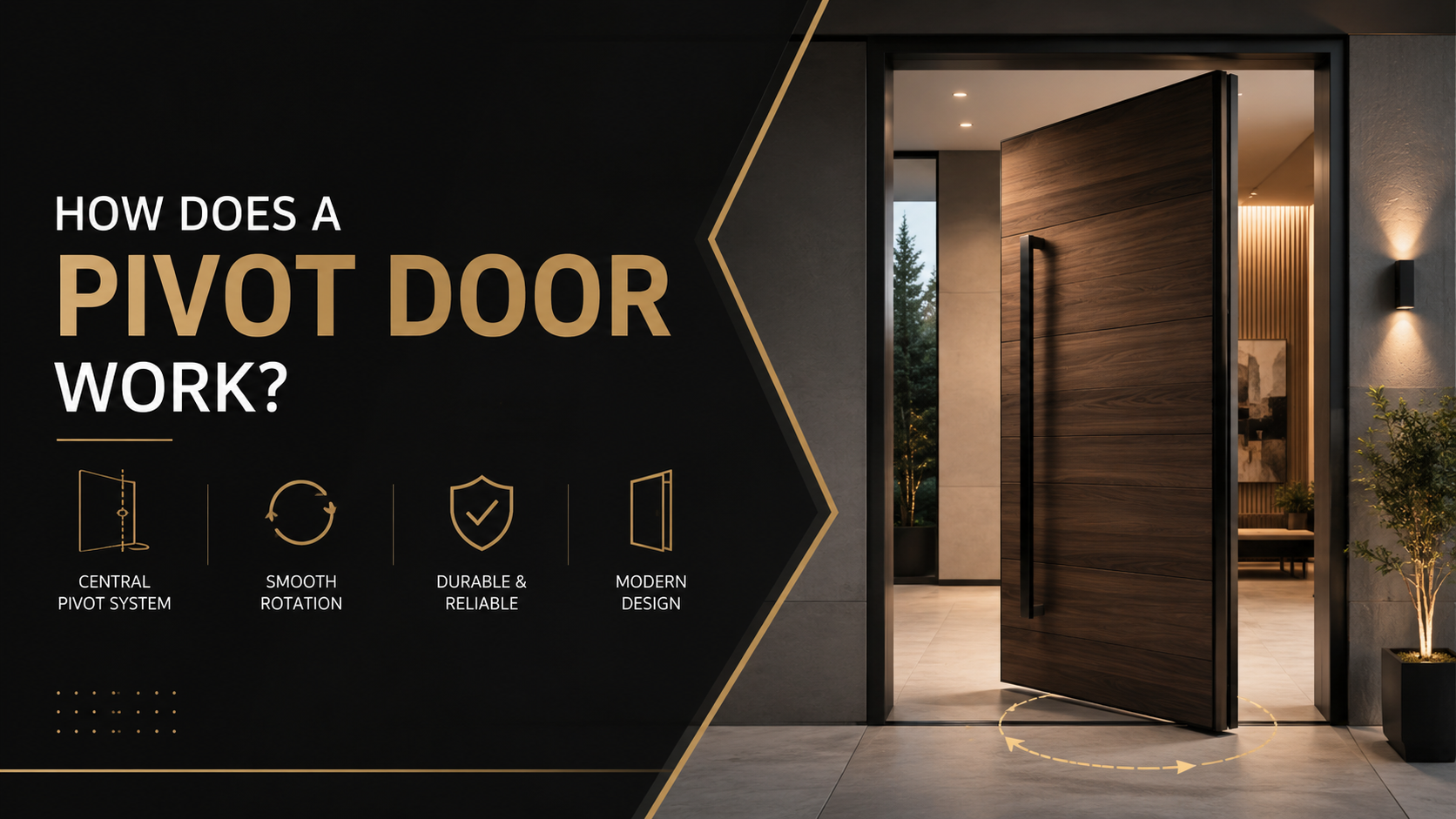
How Does a Pivot Door Work?
What is a pivot door?
A pivot door is a large door that rotates on a vertical axis, turning on a pivot point at the top and bottom of the panel instead of on side-mounted hinges. The pivot hardware sits inside the floor and the frame head, so the panel spins in place rather than swinging from one jamb. This construction routes the panel weight through the pivot points, which lets a pivot system reach about four times larger than a standard hinged door. Vision Art Aluminium, a premium aluminum systems manufacturer in Montclair, New Jersey, produces pivot doors on a Reynaers platform for residential and commercial projects across New Jersey and New York.
How does the pivot mechanism work?
The pivot mechanism replaces the side-hung hinge with two aligned bearings set on a single vertical line: a floor pivot and a head pivot. When you push the panel, it rotates around that vertical line, with one edge swinging inward while the opposite edge swings outward. A side-hung hinge, by contrast, fixes the whole panel to one jamb, so the full load pulls on that single edge. The pivot design instead splits the load between the floor and the frame head, and the bearing carries the rotation. This is why the action feels light even on a heavy leaf.
The pivot point does not have to sit at the panel edge. Many pivot doors use an offset pivot, meaning the rotation axis moves a few inches in from the edge. This offset changes the opening path: part of the panel swings back toward you while the larger part swings away. The offset also shortens the leverage arm on the bearing, which lowers stress on the hardware and keeps the panel balanced through its full swing.
Why can pivot doors be larger and heavier?
Pivot doors carry weight differently from hinged doors, and that difference is the core reason they scale up. A side hinge transfers the entire panel load to fasteners in one jamb, so size and weight stay limited by what those hinges can hold. A pivot door routes the load down to a floor bearing and up to a head bearing, both engineered to turn heavy mass smoothly. Because the pivot bearing takes vertical load rather than shear pull, a pivot system can run about four times larger than a standard door.
The offset pivot adds a second advantage: balance. With the axis set inside the panel, the weight on each side of the pivot line partly counterweights the other, so the door needs less force to start moving. Aluminum framing supports this scale because it stays strong for its weight, which keeps a tall, wide panel rigid without adding excess mass. The pairing of a load-bearing pivot and a light, stiff aluminum frame is what makes oversized glass doors practical.
What configurations and options does Vision Art Aluminium offer?
Vision Art Aluminium builds its pivot door system on a Reynaers platform in single, 2-panel, and 3-panel layouts. The single configuration is one pivoting leaf; the 2-panel and 3-panel versions combine a pivot leaf with fixed or additional moving sections for wider openings. A blinds-between-the-glass option places integrated blinds inside the sealed glass unit, so the slats stay dust-free and adjust without a separate window covering. The finish choices then split between the two faces of the door.
The interior and exterior faces use different materials. The interior comes in six wood colors, while the exterior uses a fiberglass exterior surface. This lets the inside match a room’s woodwork while the outside carries a weather-facing fiberglass skin. The configuration and finish are specified per opening, so the same mechanism supports a narrow single entry or a wide multi-panel wall of glass.
- Single panel: one pivoting leaf for a focused, oversized entry.
- A 2-panel layout pairs a pivot leaf with a fixed or moving section.
- A 3-panel layout adds further sections for the widest openings.
- Blinds-between-the-glass slats sit sealed inside the glass unit.
- Finishes offer six wood interior colors and a fiberglass exterior.
Pivot door vs side-hung door: key differences
Pivot doors and side-hung doors differ in how they carry weight, how they open, and how large they can grow. A side-hung door swings from hinges on one jamb and suits standard openings. A pivot door turns on a vertical axis and handles oversized, heavy panels. The table below sets the two mechanisms side by side.
| Feature | Pivot door | Side-hung door |
| Rotation point | Top and bottom pivots on a vertical axis | Row of hinges on one jamb |
| Load path | Floor bearing and head bearing | Single jamb |
| Maximum size | About four times a standard door | Standard opening range |
| Opening motion | Panel rotates, offset axis option | Panel swings from one edge |
| Vision Art Aluminium build | Reynaers system, single / 2-panel / 3-panel | Not applicable |
What should you consider before choosing a pivot door?
Pivot doors need floor and frame conditions that match their hardware, so a few structural points matter before you plan one. The floor pivot sets into the threshold, which means the subfloor and finished floor must accept and support that hardware. Panel size drives the rest: a larger leaf needs a level, rigid opening to swing true across seasons. Sealing also differs from a hinged door, because the rotating edge meets the frame along a turning line rather than a fixed stop.
Climate and use shape the specification too. In New Jersey and New York, a pivot door faces cold winters and humid summers, so the glass and frame handle a wide temperature range. The blinds-between-the-glass option keeps window coverings sealed away from that swing. Configuration follows the opening: a single panel fits a tall, narrow entry, while 2-panel and 3-panel layouts cover wider walls of glass.
What the pivot mechanism means for a real opening
A pivot door works by trading side hinges for a vertical axis, and that single change drives every other trait. The floor and head bearings carry weight that side hinges cannot, so a pivot system reaches about four times the size of a standard door. The offset pivot balances the panel and eases its swing, which is why a heavy aluminum and glass leaf still moves lightly. Vision Art Aluminium delivers this on a Reynaers platform in single, 2-panel, and 3-panel forms, with a blinds-between-the-glass option and a six-color wood interior set against a fiberglass exterior. The mechanism, not the styling, is what lets these doors run so large.
This content is for general informational purposes only. Product specifications, configurations, and finish options can change, so confirm current details with the manufacturer before planning a pivot door installation.
Frequently Asked Questions
What is a pivot door?
A pivot door is a door that rotates on a vertical axis, turning on a pivot point at the top and bottom of the panel instead of on side hinges. This construction moves the load onto floor and head bearings, which lets the panel run far larger than a conventional hinged door while still opening with light effort.
How does a pivot door work?
A pivot door works by spinning around two aligned bearings, one set in the floor and one in the frame head, both on a single vertical line. Pushing the panel rotates it around that line, with one edge moving inward and the other outward. An offset pivot shifts the axis inward from the edge, which balances the weight.
Why can pivot doors be so large?
Pivot doors can be large because the pivot bearings carry vertical load instead of the shear pull that side hinges take. A pivot system can reach about four times the size of a standard door. A lightweight, rigid aluminum frame keeps the oversized panel stiff without adding the mass that would strain the mechanism.
What options come with a Vision Art Aluminium pivot door?
A Vision Art Aluminium pivot door uses a Reynaers system and comes in single, 2-panel, and 3-panel configurations. A blinds-between-the-glass option seals integrated slats inside the glass unit. The interior offers six wood colors, while the exterior uses a fiberglass surface. The company serves projects across New Jersey and New York.
How is a pivot door different from a hinged door?
A pivot door differs from a hinged door in its axis of rotation. A hinged or side-hung door swings from hinges fixed to one jamb, while a pivot door turns on a vertical axis through top and bottom pivots. The pivot path spreads the load between floor and head bearings, so it supports much larger and heavier panels.