

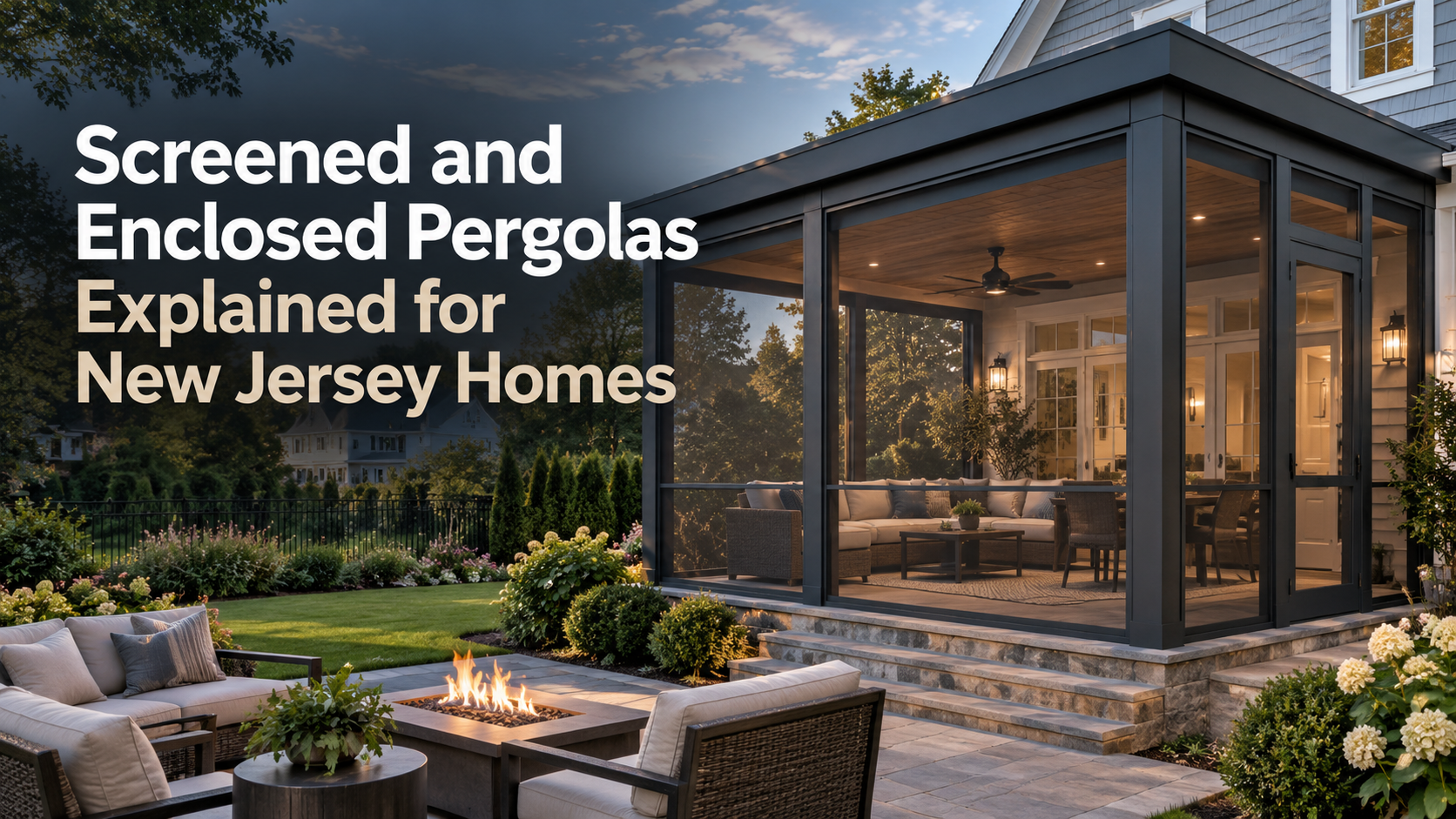
Screened and Enclosed Pergolas Explained for New Jersey Homes
Enclosing a pergola happens at four levels, and each level stops a different list of things. A screened pergola, the first level, keeps insects out and cuts most of the wind while leaving the space open to outside air. Fixed insect screening does the bug half of that job and little else. Sliding or folding glass panels add driving rain, dust and cold draft control, plus a real drop in street noise. Solid side panels give you a wall on that face: privacy, blocked sightlines, full shade. What none of the four do on their own is make the space warm. They change what passes through the sides of the structure without adding a heat source or any insulation.
Homeowners weighing aluminum pergolas in New Jersey against a room addition usually want one of two things: more usable evenings on a patio they already own, or a space they can sit in during February. Screens answer the first cheaply and cannot answer the second at all.
What Each Enclosure Level Actually Stops
Enclosure level | Insects | Wind | Driving rain | Dust and pollen | Privacy | Warmth held |
Motorized zip screens | Yes with fine mesh | Most of it | Partial | Some | Daytime with low openness | Very little |
Fixed insect screening | Yes | Little | No | Some | Low | None |
Sliding or folding glass | Yes when closed | Yes | Yes | Yes | Only if tinted | A few degrees in sun |
Solid side panels (one face) | Yes | Yes | Yes | Yes | Full | Wind block only |
The warmth column is the one people misread. A wind block feels like heat because moving air pulls warmth off skin faster than still air does. Cut a 12 mph breeze on a 58 degree evening and the patio feels far warmer than the thermometer says.
How Zip Screens Work and Why the Side Tracks Matter
A zip screen is a mesh panel wound on a motorized roller tube inside a head box at the top of the bay. Both vertical edges of the fabric carry a thickened edge, a welded zipper or a beaded keder, that rides inside a track built into the pergola post or a channel added to it. When the motor lowers the screen, those edges stay captured in the track for the full drop.
That capture is the difference between a screen and a curtain. A curtain or loose roller blind is held only at the top and weighted at the bottom at best, so wind gets behind it, lifts it, and either flaps it into noise or pulls the hem apart. A tracked screen has no free edge to lift, so pressure loads into the tracks and the frame instead of the fabric. Published wind ratings vary by fabric, bay width and mounting, but the principle holds: retained edges stay put where free edges do not. Wider bays flex more and carry lower ratings, so a long run is often split into two screens. A closer look at what are zip screens and how do they work covers the motor, fabric and track details.
Zip screens close the sides, not the roof, so rain protection still comes from the roof above. And because the fabric rolls away in seconds, a screened bay reverts to an open bay on demand.
What Is the Best Type of Screen to Keep Out Bugs?
Mesh density decides it, not brand or color. Standard insect screening runs around 18 by 16 strands per inch and reliably stops houseflies, wasps and mosquitoes. It does not stop no see ums, the biting midges that pass where a mosquito cannot: they are roughly one to three millimeters long and slip through standard openings untouched. Blocking them takes a tighter weave, usually sold as no see um mesh at about 20 by 20 or finer.
The trade-off is real. A tighter weave moves less air and gives a darker, hazier view out, and on a still August evening it feels noticeably stuffier. Solar mesh is a third category, measured by openness factor, the share of the panel that is open weave. Roughly 1 to 3 percent openness gives strong daytime privacy and heavy shade with a poor view, while 5 to 10 percent keeps the view usable and blocks less sun.
Choose by what is actually biting in your yard. Inland New Jersey properties away from standing water are typically a mosquito problem, and standard mesh handles it. Homes near tidal marsh, a wooded creek line or a pond often deal with midges, and there the finer mesh earns the airflow it costs.
Glass Panels and Solid Sides at the Heavier End
Closed glass panels stop wind and rain completely on that face, keep pollen and road dust out and quiet the space. Single glazed panels in standard aluminum frames also collect solar gain on a bright afternoon, lifting the inside temperature a few degrees, then give it back once the sun drops, because nothing in the assembly holds heat.
Solid panels do the same work opaquely and add what glass cannot: a blocked sightline. On a property line, beside a neighbor’s window, or on the windward face of an exposed lot, one solid side often does more for comfort than screening all four.
What a Screened Pergola Buys You in a New Jersey September and October
Late season is where the math works. Through September, daytime highs across most of the state usually sit in the 70s and fall into the 50s and 60s after sunset. October runs cooler, with afternoons often in the 60s and evenings reaching the 40s by month end. Mosquito activity does not stop until a hard frost, which in most years lands between mid October and early November, later at the shore and in the southern counties than in the northwestern hills.
That overlap, biting insects still active while evenings turn breezy and cool, is what screens solve. A screened bay on a covered patio commonly adds several usable weeks in autumn and a similar stretch in spring, though the gain moves with exposure: an open lot or waterfront gains far more from wind blocking than a yard sheltered by mature trees.
The point where it stops paying is easy to feel. Once evenings settle into the mid 40s and below, blocking wind is no longer enough, and any heat you add goes into an open volume with nothing around it. Patio heaters stretch that a little at real running cost. By late November, a screened structure is a covered outdoor space you pass through, not a room you sit in.
Where an Enclosed Pergola Stops and a Sunroom Starts
An enclosed pergola is not a sunroom, and the difference is structural rather than a matter of degree. Four things separate them.
There is no thermal envelope. Screen mesh has no insulating value, and single glazed panels in frames without a thermal break lose heat as fast as they gain it. No insulated glazing, no insulated roof or wall assembly, no insulation under the slab.
There is no conditioned air. The structure is not tied into the home’s heating and cooling and is not built to hold a set temperature.
There is no continuous air barrier. Tracked screens and panel systems are weather resistant, not sealed. Air still moves at the roof line, at panel joints and at the slab edge.
And the approval path is usually different. Permitting in New Jersey is handled municipally, so specifics vary town to town, but an open or screened accessory structure is generally reviewed for zoning, setbacks, lot coverage and structural attachment, while a conditioned addition pulls in energy code compliance, foundation requirements and fuller building review. Ask your municipal construction office before assuming either path, especially if the structure attaches to the house.
If what you want is a space usable in January, the answer is four season sunrooms in New Jersey rather than a heavier pergola enclosure. Adding glass to an unconditioned structure gets expensive without ever crossing into conditioned space. Screening is the least expensive way to stretch the outdoor season. A sunroom is the only way to take the season out of the question.
Common Questions About Screened Pergolas
Can screens be added to a pergola that is already installed?
Often yes, provided the posts and beams can carry the tracks and head boxes. Retrofit success depends on bay width, post depth and whether the structure was engineered for side loads. A motorized system needs a head box across each bay and power run to the motor, so a pergola with clean square openings and accessible wiring converts far more simply than one with irregular bays.
Do zip screens keep rain out?
Partially. A closed zip screen sheds light rain and blocks blowing spray from the side, but mesh is not waterproof and driving rain will pass through it. Real rain protection comes from the roof above, a louvered roof rotated closed or a retractable roof extended, with the screens handling side exposure only.
How long does pergola screen fabric last in New Jersey weather?
A decade or more is reasonable for quality mesh, with fading and edge wear showing before any failure. Freeze and thaw cycles, coastal salt air and steady UV on a south facing bay all shorten that. Keeping the tracks clear of grit and leaf litter matters most, because a packed track is the common cause of damage to the fabric edge.
Does a screened pergola need a permit in New Jersey?
Usually yes, though the requirement is set by your municipality rather than by one statewide rule. Most towns review pergolas as accessory structures for zoning, setbacks and lot coverage, with structural review when the pergola attaches to the house or passes a size threshold. Adding screens rarely changes the category by itself. Confirm locally before ordering anything.