

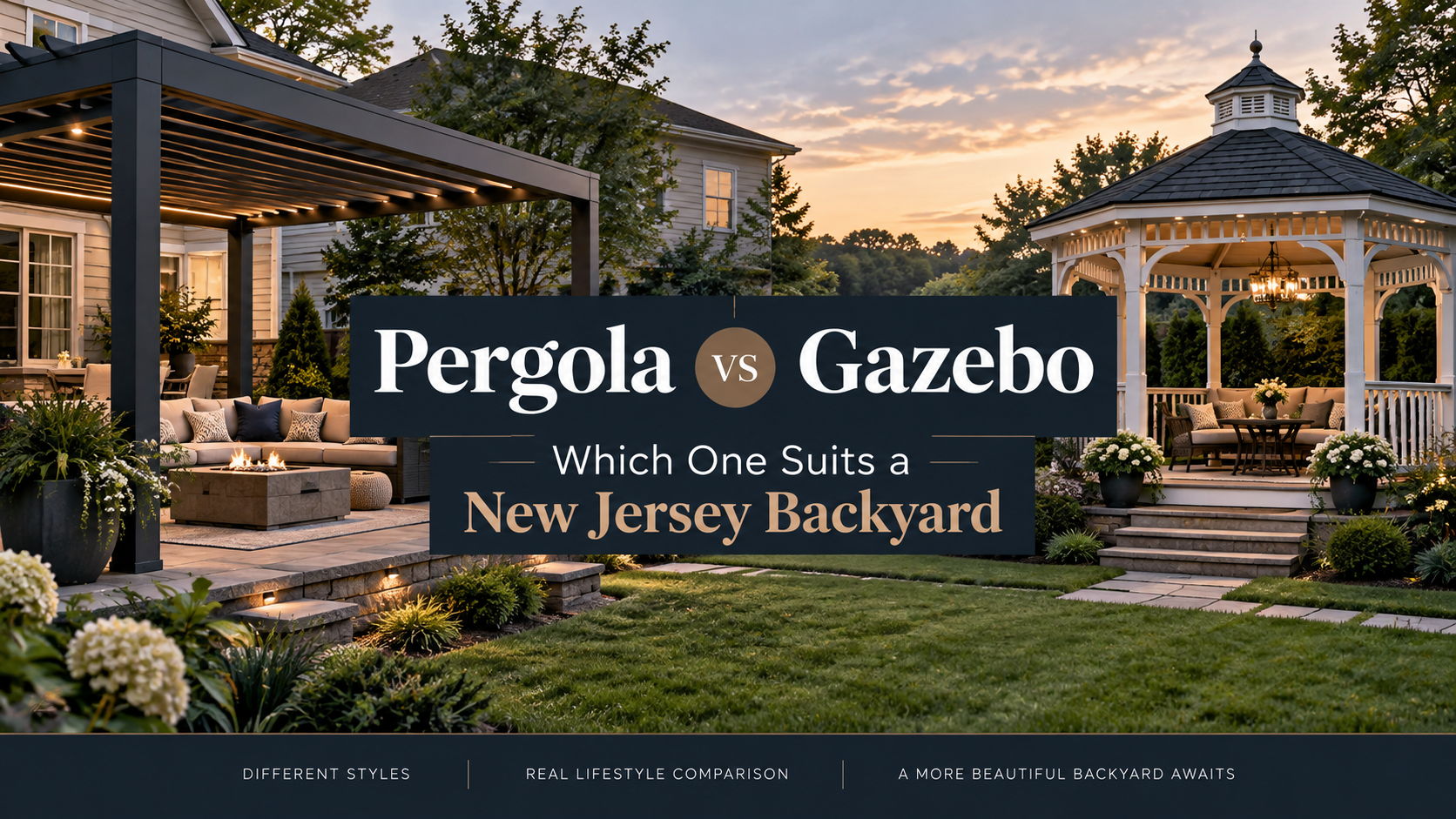
Pergola vs Gazebo – Which One Suits a New Jersey Backyard
Late September is usually when this decision gets forced, with the patio slab poured, the furniture still out and the first run of cold rain close. In practical terms, pergola vs gazebo comes down to one structural fact: a pergola is an open sided frame whose roof is built to manage sunlight, air and, on motorized systems, rain, while a gazebo is a small freestanding building with a fixed solid roof that gives the same cover every day of the year. A pergola shapes the conditions on your patio, while a gazebo replaces them with a sheltered room that happens to have open walls.
That difference also explains why the comparison is no longer the one your parents made. A wooden pergola with fixed slats genuinely was the weaker choice in bad weather, but a motorized aluminum roof takes on work that used to belong to a gazebo.
Pergola vs Gazebo – The Structural Difference
A pergola is posts, beams and a roof system, with the sides left open unless you add screens or panels. The roof is the variable: fixed wooden slats, rotating aluminum blades that pivot from open to fully closed, or a fabric panel that retracts along the frame. Pergolas are commonly attached to the house over an existing patio or deck.
A gazebo is a small building. Fixed roof, usually shingled or metal, a footprint that is often octagonal or square, and frequently a railing and a raised floor.
Criterion | Pergola | Gazebo |
Roof | Slats, rotating aluminum blades or a retractable fabric panel | Fixed solid roof, built once and never adjusted |
Light control | Adjustable on motorized systems: full sun, filtered shade or a closed roof | Constant deep shade, identical in every season |
Rain behavior | None on a slatted wood frame; a closed roof drains through an integrated gutter network | Sheds off the roof edge, typically without gutters, so runoff lands around the structure |
Sides | Open by default, with optional zip screens or panel enclosures | Often railed, sometimes screened, with a fixed perimeter |
Placement | Attached over a patio or deck, or freestanding | Almost always freestanding as a garden feature |
How the Shade Actually Behaves Through a New Jersey Season
A gazebo gives you one shade condition. That is an advantage on a humid July afternoon and a drawback in late October, when a New Jersey backyard offers only a handful of pleasant hours and most of them depend on direct sun.
A pergola behaves differently depending on its roof. Fixed wooden slats throw a striped shadow that works when the sun is high overhead at midday and poorly through autumn, when low angled sun comes in sideways underneath the slats entirely.
An adjustable aluminum roof removes the problem, because the blade angle is set for the hour rather than fixed for the life of the structure. Blades rotating through an adjustable range of up to 135 degrees can be tilted against a low western sun, angled part way for filtered light and ventilation, or opened almost completely in mid October when the point of sitting outside is to catch warmth rather than avoid it. That is where modern aluminum pergolas in New Jersey separate themselves from the older idea of a pergola as a summer only frame.
Snow Load and Rainwater Drainage Through a New Jersey Winter
Autumn here brings long soaking rain and coastal storms that drive water sideways, and winter brings wet, heavy snow rather than light powder, followed by freeze and thaw cycles that work at every joint and fastener.
A fixed gazebo roof sheds rain well enough. The issue is where the water lands. Most gazebos are built without gutters, so runoff falls in a ring at the drip line, right where you walk in and out: over a wet autumn it churns mulch and stains a stone border, and in January it becomes an ice collar around the entrance. Snow behavior depends on pitch and material, since a steeper metal roof sheds a load while a shallow shingled roof holds wet snow until it melts.
An adjustable aluminum roof approaches both problems from the other direction. The aluminum louvered pergola Sky Blade closes its rotating blades into a sealed plane and moves water into a four sided gutter network that carries it down through the frame instead of dumping it around the perimeter. Optional rain sensors close the roof on their own, which matters because most autumn rain here starts while nobody is standing on the patio. Retractable systems handle it with a fabric roof, a horizontal gutter profile in the front beam and a concealed drainage network.
The honest trade: an adjustable roof only protects the space once it is closed, while a gazebo roof never needs a decision, power or a motor.
Maintenance and Cost Over Time
Maintenance in this climate is mostly a question of how much wood is exposed. A wooden pergola has beams and rafters that need sealing on a cycle, and our humidity plus freeze and thaw shortens that cycle. A gazebo of similar size has more surface to look after, since it adds a roof covering, railings and usually a floor deck. Powder coated aluminum changes the arithmetic: the frame gets rinsed rather than refinished, and the parts needing periodic attention are the moving ones, meaning motors, sensors and seals.
On cost, a basic slatted wood pergola is typically the least expensive way to define a patio. A built gazebo with a finished roof, railings and a floor typically costs more, because it is a small building with foundations and roofing. A motorized aluminum pergola typically sits above both, as an engineered system custom sized to the slab it covers.
Pros and Cons of a Pergola
The strengths:
- Open sides keep sightlines and airflow, so a small backyard does not feel divided.
- Attaching to the house extends the kitchen or living room outward instead of creating a destination you have to walk to in the rain.
- Adjustable roofs let you choose sun, filtered shade or full cover on the same afternoon.
- Aluminum construction with motorized operation is engineered for snow and wind rather than for summer alone.
- Optional zip screens, side enclosures, LED lighting and smart controls extend both shoulder seasons.
- Custom sizing matches an existing patio, deck, pool surround or rooftop terrace instead of forcing a standard footprint.
The trade-offs:
- A fixed slat pergola gives partial shade and no rain protection, so the cheapest version delivers the least seasonal value.
- Motorized systems add moving parts, a power supply and controls, which is more to specify and more to service.
- Without side screens, wind driven rain still reaches the space even when the roof is closed.
- Freestanding installations need footings and anchoring, which adds site work on a lawn or an older patio.
When a Gazebo Is the Better Choice
If you want a destination at the far end of the property, something you walk out to rather than step onto from the back door, the self contained form is the right one. If the house is colonial or Victorian and the yard is landscaped around it, a gazebo reads as a garden feature in a way an aluminum frame does not. A fully screened gazebo is also the simpler answer if mosquitoes are the main complaint, and where there is no power supply, a fixed roof is the more sensible build.
Matching the Structure to How the Yard Gets Used
If the space you want is an outdoor room attached to the house, used for dinner in June, coffee in October and shelter during a rainstorm, an adjustable roof does more work for more months. If it is a shaded seating spot away from the house with no controls to think about, a gazebo fits better.
Look at what is under the structure, since an existing slab or deck favors an attached pergola while a lawn location means footings for either build. Then confirm approvals: both are generally treated as accessory structures in New Jersey towns, and most municipalities want a zoning review or a building permit plus setback compliance, so check the permit rules for a pergola in New Jersey with your township first.
Frequently Asked Questions
Is a pergola or a gazebo better for rain in New Jersey?
A gazebo protects you from rain without any action on your part, but it usually dumps the runoff around its own edge. A pergola with a louvered or retractable roof gives comparable overhead cover once the roof is closed, and it manages the water better, because drainage runs through the gutters and posts instead of falling at the drip line.
Can a pergola handle New Jersey snow?
An aluminum pergola engineered for four season use is built for snow and wind loads, unlike a light seasonal frame or a fabric canopy, provided it is specified for year round conditions and installed with proper footings and anchoring. An open slatted wood pergola carries no snow load, but it offers nothing in winter either.
Do pergolas and gazebos take up the same space in a small yard?
Visually, no. A gazebo occupies its footprint as a solid object with floor, railings and roof, which can dominate a small yard and cut the sightline from the house to the garden. A pergola attached to the house covers the patio without adding a separate object, so the yard beyond stays open.
Can you enclose a pergola so it works like a gazebo?
Partly. Zip screens and panel enclosures on the sides, combined with a closed roof, give you a sheltered and largely wind protected space that stays usable well into the cold months. It is not a framed building with permanent walls, and it is not an insulated room, but for autumn dinners it covers most of what people want from a gazebo.