

Do You Need a Permit for a Pergola in New Jersey?
Do pergolas need a permit in New Jersey?
A pergola permit is the written approval a New Jersey municipality issues before an outdoor shade structure is built on a residential or commercial lot. New Jersey regulates construction through the Uniform Construction Code, the statewide building rule administered under the Department of Community Affairs. Most townships require a building permit for a permanent pergola, while some exempt very small or fully detached structures below a set size. The exact threshold is set by each local building department, so the rule that applies in Montclair can differ from the one in Hoboken or Paramus.
Pergola permit requirements split into two layers: the construction permit (does the structure meet the building code) and the zoning review (does the structure fit the lot’s setback and coverage limits). A homeowner usually needs both signed off before installation. Vision Art Aluminium, a Montclair, New Jersey contractor serving New Jersey and New York, prepares the drawings and handles permits as a standard part of its build process. That work feeds the township approval directly.
What is a pergola permit?
A pergola permit is a municipal authorization that confirms a planned pergola meets local building and zoning rules before any footing is poured. The permit ties to the New Jersey Uniform Construction Code, which adopts national model codes for structural, wind, and footing standards. A reviewer checks the structure’s size, height, anchoring method, and distance from property lines. Once the file passes, the township issues a permit number and schedules inspections.
Pergola permits cover both attached and freestanding designs, but the review depth differs. An attached pergola connects to the house and shares a wall or roof line, so it counts as a building addition in most townships. A freestanding pergola stands on its own posts, so reviewers focus on footing depth, wind anchoring, and setback distance rather than the connection to the home.
Do attached and freestanding pergolas follow different rules?
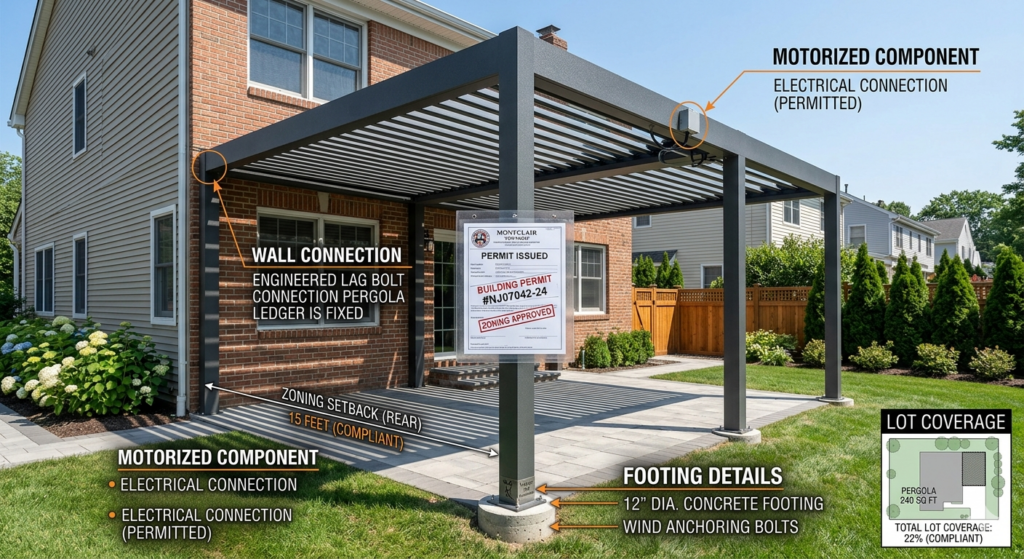
Attached and freestanding pergolas trigger different permit paths in most New Jersey townships. An attached unit fixes to the dwelling, which means the reviewer treats it as an extension of the house and checks the connection, load transfer, and roof interaction. A freestanding unit sits apart from the home, so the review centers on the foundation, the posts, and the lot setback. The table below outlines the typical pattern; the local building department sets the binding version.
| Factor | Attached pergola | Freestanding pergola |
| Permit type | Building permit, treated as an addition | Building or accessory-structure permit |
| Main review focus | Wall connection, load transfer, roof line | Footings, posts, wind anchoring |
| Zoning check | Setback plus lot coverage | Setback plus accessory placement |
| Common exemption | Rarely exempt once fixed to the home | Sometimes exempt below a small size limit |
| Inspection points | Footing and final, plus connection | Footing and final |
When does a pergola need a permit in New Jersey?
A pergola needs a permit in New Jersey when it is a permanent structure anchored to the ground or attached to a building. Permanence is the key test: a unit set on footings, bolted to a slab, or fixed to the house is permanent and falls under the Uniform Construction Code. Size and height thresholds also matter. Many townships waive the permit for small detached shade structures below roughly 100 to 200 square feet, but that figure varies and must be checked locally.
Permit triggers tighten when the pergola adds a roof, electrical wiring, or a gas line. A motorized louver or retractable system that needs power draws an electrical permit on top of the building permit. Vision Art Aluminium installs motorized SkyFlow retractable and SkyBlade louver pergola systems, both of which carry powered components that townships review as part of the file.
- The pergola attaches to the house or a deck.
- The structure sits on permanent footings or a slab.
- The design adds a solid or louvered roof for weather cover.
- Motorized or electrical parts require wiring.
- The footprint exceeds the township’s exemption size.
How do zoning setbacks affect a pergola?
Zoning setbacks are the minimum distances a structure must keep from property lines, and they shape where a pergola can legally stand. Each New Jersey municipality publishes setback rules in its zoning ordinance, with separate figures for front, side, and rear yards. A pergola placed too close to a boundary fails the zoning review even if the construction drawings are sound. Reviewers measure from the lot line to the nearest post or edge of the structure.
Lot coverage is the second zoning limit that affects pergolas. Coverage caps the share of a lot that buildings and hard surfaces can occupy, often expressed as a percentage of total lot area. A large pergola can push a property over its coverage ceiling, which forces a redesign or a variance request. A variance, the formal exception a zoning board grants, adds weeks to the timeline and is decided case by case.
What does the New Jersey township approval process look like?
The township approval process moves through a fixed sequence of filing, review, and inspection. A homeowner or contractor submits drawings and application forms to the local construction office, which routes the file to the building and zoning reviewers. After approval, the office issues a permit number, and work can begin. Inspectors then verify the footings and the finished structure before closing the permit. The steps below describe the common New Jersey path.
- Prepare site drawings, a plot plan, and structural details.
- File the construction permit application with the township.
- Pass the zoning review for setbacks and lot coverage.
- Receive the permit number and post it on site.
- Build to the approved drawings.
- Pass the footing inspection, then the final inspection.
Approval timing depends on the township workload and whether a variance is needed. A straightforward freestanding pergola can clear review in a few weeks, while an attached unit near a setback line takes longer. Vision Art Aluminium folds drawings and permits into a seven-step build sequence, which keeps the documentation aligned with what the local office expects to see.
Which documents does a New Jersey pergola permit need?
A New Jersey pergola permit application needs a defined document set before the township will start its review. The construction office checks that the drawings show dimensions, footing depth, and anchoring, and that the plot plan marks the structure’s distance from each property line. Missing items stall the file. Gathering the full set first shortens the approval window and reduces back-and-forth with the reviewer.
- A completed construction permit application form.
- A plot plan showing the pergola and setback distances.
- Structural drawings with post, beam, and footing details.
- Manufacturer specifications for the pergola system.
- An electrical permit application for motorized models.
How does a contractor handle the permit work?
A contractor handles permit work by producing the drawings, filing the application, and coordinating inspections on the homeowner’s behalf. New Jersey allows licensed contractors to act as the applicant of record for a construction permit, which shifts the paperwork burden away from the property owner. The contractor’s drawings must still satisfy the same Uniform Construction Code and local zoning rules a homeowner would face.
Vision Art Aluminium, based at 28 Valley Road, Suite 1, Montclair, NJ 07042, builds permits and drawings into its standard process for an aluminum pergola project. The firm serves New Jersey and New York and sources systems from European partners including Reynaers and Schüco. Handling the permit in-house keeps the structural drawings and the township submission consistent, since the same team designs and documents the build.
The verdict on pergola permits in New Jersey
A permanent pergola in New Jersey almost always needs a permit, and the rule scales with the structure’s size, attachment, and power. Attached pergolas read as building additions and face a fuller review than freestanding units, which sometimes qualify for a small-size exemption. Zoning setbacks and lot coverage limits decide where the structure can stand, independent of whether the construction drawings pass. Motorized systems add an electrical permit to the file. Across every case, the binding numbers come from the local township building department, not a single statewide figure, so the practical first step is confirming the threshold that applies to a specific address.
This content is for general information only and is not legal or code advice. Local pergola permit requirements vary by township, and you should verify the current rules with your local building department before building.
Frequently Asked Questions
Do I need a permit for a freestanding pergola in New Jersey?
A freestanding pergola usually needs a permit in New Jersey when it sits on permanent footings or a slab. Some townships exempt small detached shade structures below a set size, often around 100 to 200 square feet, but the figure varies. Confirm the exemption threshold with your local building department before you start, since each municipality sets its own limit.
Does an attached pergola need a building permit?
An attached pergola almost always needs a building permit in New Jersey because it connects to the house and counts as an addition. The reviewer checks the wall connection, load transfer, and roof line under the Uniform Construction Code. Setback and lot coverage rules also apply. The local construction office issues a permit number once the drawings and zoning review both pass.
How long does pergola permit approval take?
Pergola permit approval in New Jersey typically takes a few weeks for a straightforward freestanding structure. Timing depends on the township workload and whether the file passes zoning review on the first pass. An attached unit near a setback line, or any design needing a variance, takes longer. A complete document set at filing shortens the window and avoids review delays.
Do motorized pergolas need an electrical permit?
Motorized pergolas need an electrical permit in New Jersey in addition to the building permit. Powered systems such as retractable canopies or rotating louvers carry wiring that the township reviews for safety. The electrical permit covers the connection, while the building permit covers the structure. Both must clear before the install closes out and the final inspection signs off the work.
Can a contractor pull the pergola permit for me?
A contractor can pull the pergola permit for you in New Jersey by acting as the applicant of record. A licensed contractor files the application, supplies the drawings, and coordinates the footing and final inspections. This shifts the paperwork off the homeowner. The drawings still must meet the Uniform Construction Code and the local zoning ordinance, so the contractor builds the file to township specifications.