

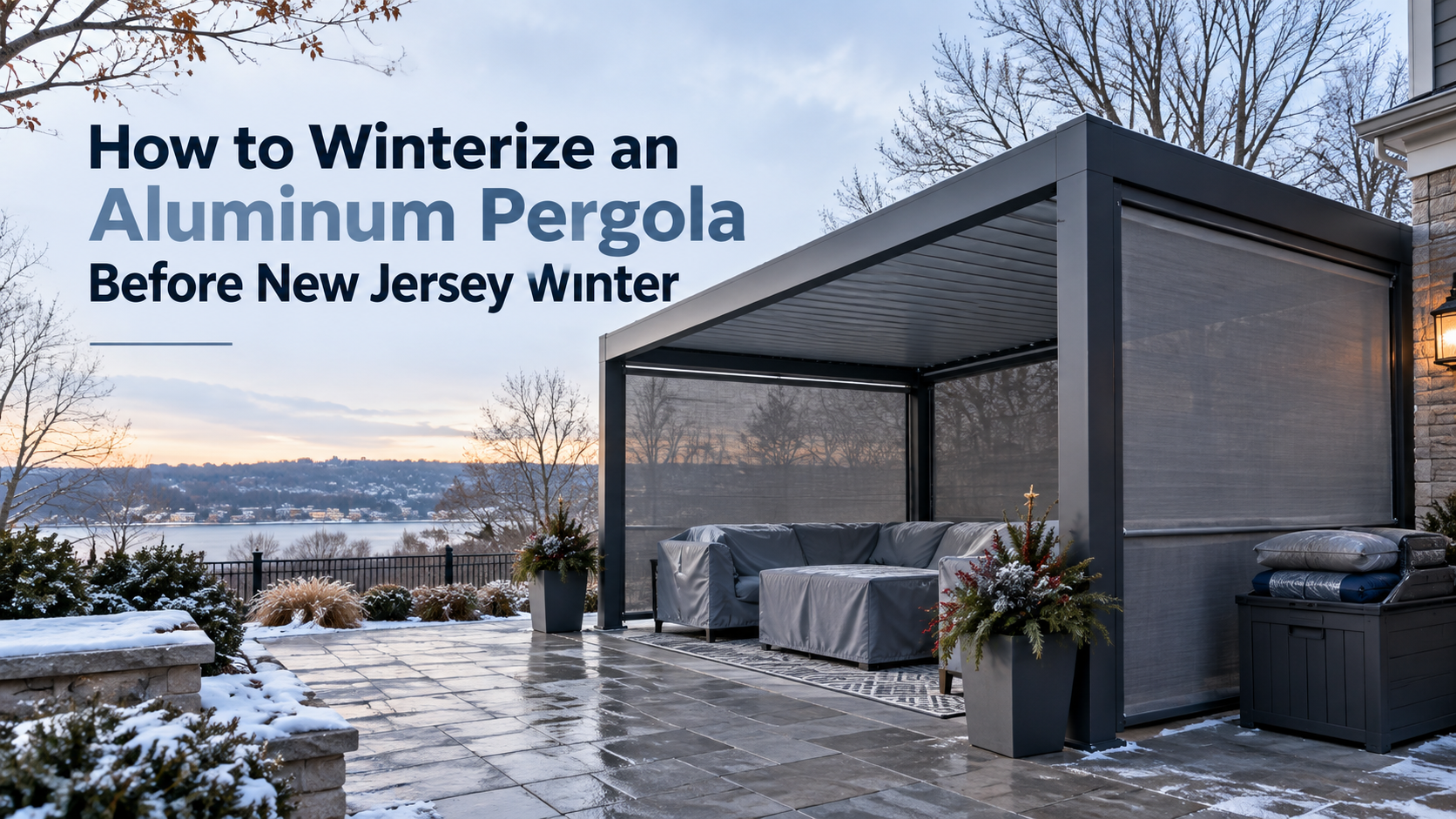
How to Winterize an Aluminum Pergola Before New Jersey Winter
The last warm weekend in October usually gives it away. Oak leaves are dropping into the roof channels, the furniture is under covers, and the roof has not moved since Labor Day. Getting a pergola in winter through a New Jersey season comes down to five things: the right roof position, clear drainage, a motor and sensors tested while the weather is mild, fabric taken down, and dry electrical connections. Aluminum does not rot or rust, so this is not about protecting the metal. It is about the moving parts, the water path and the wiring.
Start With the Roof Position
Louver position is the decision that matters most, and the one homeowners most often get wrong. A bioclimatic roof closes against rain, so the instinct is to shut it tight and walk away for four months. That is right for rain and wrong for snow, because closed blades form a continuous surface and whatever lands on it stays until it melts. Coastal Monmouth and Ocean County storms deliver wet, dense snow that gains weight fast, while inland Sussex and Warren snow falls lighter but piles deeper.
Two positions work. Open blades let snow fall through, keeping load off the roof and leaving the patio to clear. Closed blades hold the snow but must be cleared before the next storm stacks on the first. A partial tilt fails, turning each blade into a small shelf where a freeze thaw cycle welds the accumulation in place. A rotating blade system such as the aluminum louvered pergola Sky Blade makes that a deliberate choice, since the panels turn through an adjustable range of up to 135 degrees rather than sitting fixed. Ask your installer which position your span was engineered for.
One safety note: never climb onto a pergola roof to push snow off, and do not swipe at a loaded roof from a ladder. Clear what you can reach from the ground with a soft-edged rake and call the installer for the rest.
Clear the Water Path Before the First Hard Frost
New Jersey sees its first hard frost anywhere from early October in the northwest counties to well into November along the shore. Finish this work before that date in your county, because it gets harder once channel water freezes overnight and thaws by afternoon.
An advanced drainage system moves rainwater through the frame, along the beams and down through the posts. That path is invisible, which is why it gets neglected, and a blocked channel that is only a puddle in July becomes an ice dam in January that expands and can lift a seal. Work through it in this order:
- Sweep leaves off the blades while everything is dry, since wet leaves pack down instead of lifting.
- Open the blades fully and clear the perimeter gutter channel with a soft brush, never metal, which scratches the powder coating.
- Flush the channels with a garden hose and watch where the water exits at the base of each post.
- Check that the ground around that outlet drains away from the patio, since a slab sloping back toward the house ices over where people walk.
- Wipe the seals and gaskets, then look for any section gone brittle, flattened or pulled loose from its groove.
- Wash the frame with mild soap and dry it, since road salt and coastal air leave a film that etches the finish.
If water pools along the beam instead of running out, note the spot and stop. That is a levelling or blockage issue for the installer.
Test the Motor and Sensors While It Is Still Mild
Motorized systems fail in the cold for one reason above all: nobody tested them in the fall. A gearbox that hesitates on a 55 degree afternoon will refuse on a 20 degree morning, exactly when you need the roof to move.
Run a full cycle from closed to open and back, twice, and listen. A healthy gear driven mechanism operates below 40 dB, quieter than normal conversation. Grinding or a rhythmic knock is a mechanical signal, not a quirk to live with. Watch for blades that lag or stop short of closed, because an incomplete seal is where winter water gets in. Then the electronics:
- Replace the remote battery now rather than in February.
- Confirm the smartphone app still moves the roof, not just the handheld remote.
- Test the rain sensor with a hose and check the wind sensor per the manual. Nor’easters bring sustained wind loads, and an unverified sensor is the wrong thing to discover mid storm.
- Decide what the automation should do all winter. Many owners disable rain automation for the season so the roof does not cycle in freezing drizzle, the fastest way to ice a mechanism.
Fabric Roofs, Screens and Side Elements
Anything textile comes down or comes in. A retractable fabric roof such as Sky Flow should be retracted into its housing dry, never rolled away damp, because moisture trapped in a closed cassette produces mildew that spring cleaning never fully removes. Extend it on a dry, breezy afternoon, let it air, then retract it.
Zip screens follow the same logic: roll them up, secure them, and clear grit from the tracks before it freezes in. Blackout panels and removable glass get cleaned and either latched or stored flat, since a half latched panel rattles all winter and wears its hardware. Cushions and rugs go inside too, because water held under a rug through freeze thaw cycles damages the surface below.
Lighting, Heaters and Electrical Connections
Integrated LED lighting is often the reason a pergola gets used in December at all. Turn every circuit on, look for a strip that has dimmed or gone dark, and confirm the driver housing and junction box are sealed. A cracked lens, exposed conductor, corroded terminal or moisture inside a fixture is a stop sign: leave it off and book a qualified installer or licensed electrician. Electrical work at roof height, on a circuit energized through freezing rain, is not homeowner territory.
Heaters need their mounts checked, since a windy season loosens brackets. Clear dust from the element housing and confirm the outlet’s ground fault protection trips and resets.
The Pergola in Winter Checklist
Task | When | Why it matters |
Set the winter louver position | Before first snowfall | Snow stacks on a tilted roof |
Clear the roof and gutter channels | After the leaf drop | Blocked channels become ice dams |
Flush drainage and check outlets | Before first hard frost | Water must leave, not freeze inside |
Run two motor cycles and listen | A mild autumn day | Cold exposes hidden wear |
Test the rain and wind sensors | Before nor’easter season | Unverified automation is untrustworthy |
Retract and dry fabric and screens | A dry breezy day | Damp fabric grows mildew |
Inspect LED and heater connections | Before winter use | Wiring needs a sealed enclosure |
Book a service visit | Late October | Catches seal and gearbox issues early |
When to Bring in the Installer
Some of this list belongs to a homeowner with a free afternoon. Some of it does not. Roof height, open electrical enclosures, the gearbox or blade linkage, and water pooling where it should not, all of that is service work, and booking it in late October rather than after the first storm is the difference between replacing a seal and repairing a joint. It is also the moment to ask whether the slab beneath the frame needs attention before it freezes. Post spacing, drainage routing and roof type are climate decisions before they are style decisions, which is how aluminum pergolas in New Jersey should be specified in the first place.
Frequently Asked Questions
Should I cover my aluminum pergola for the winter?
No, and a full tarp usually causes more harm than good. Powder coated aluminum needs no shielding from cold, and a tarp traps moisture against the frame while creating a solid surface that collects snow and wind load the frame was never built to carry.
Can I leave the louvers closed all winter?
You can, provided you clear the snow before the next storm and your installer has confirmed that position for your span. The risk is not one snowfall. It is the second landing on a layer that has already frozen hard.
Does the motor need to run during the winter?
Cycle the roof once or twice a month on a dry, mild day so the gearbox and linkage do not sit in one position for months. Do not operate it when the blades are iced or snow loaded, since forcing a frozen mechanism damages the linkage.