

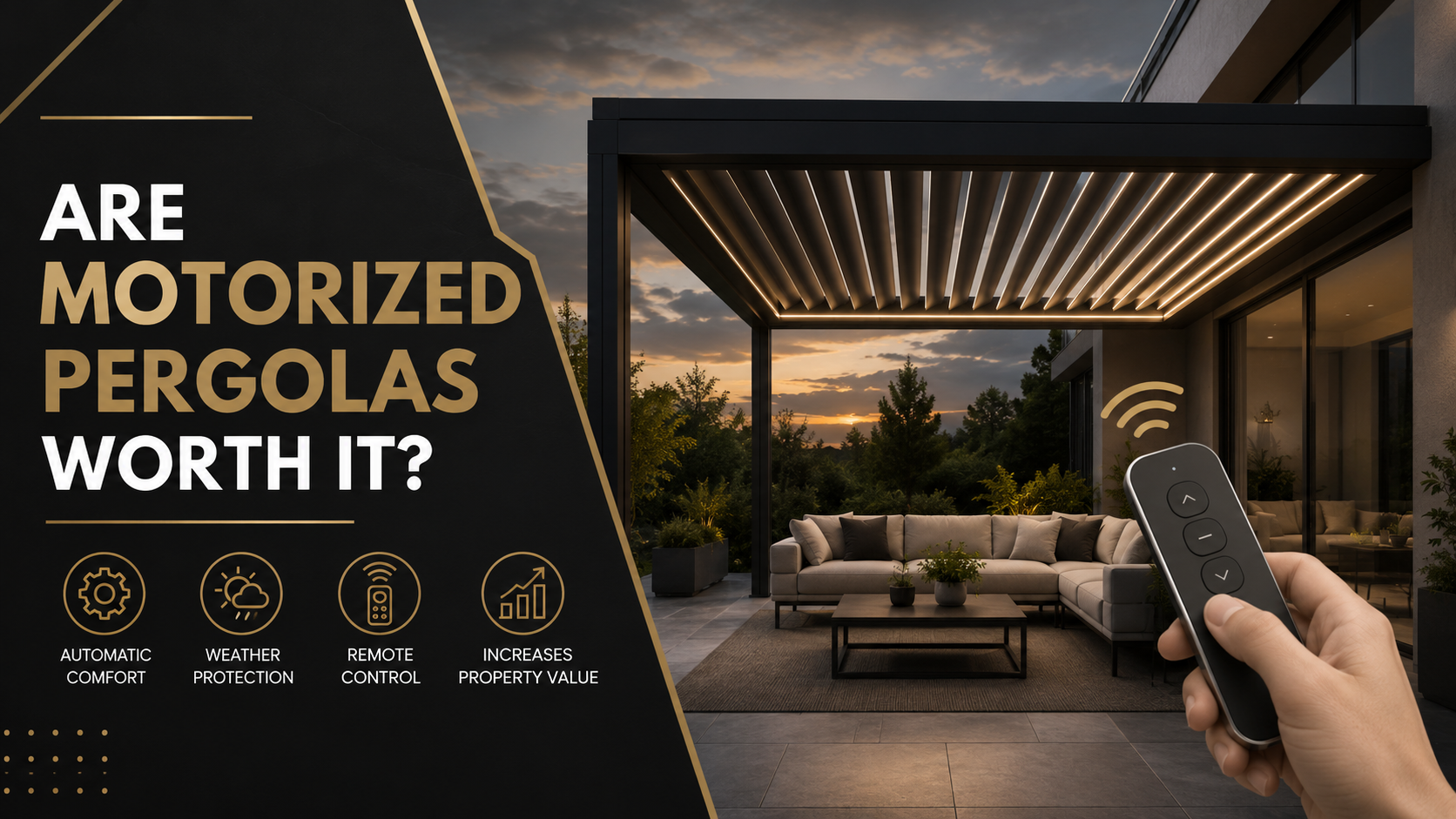
Are Motorized Pergolas Worth It?
What is a motorized pergola?
A motorized pergola is an outdoor shade structure with a powered roof that opens, closes, or retracts at the press of a button. Vision Art Aluminium, a premium aluminum systems maker in Montclair, New Jersey, builds two such systems for homes and businesses across New Jersey and New York. The SkyBlade Aluminum Louver Pergola is a bioclimatic system, meaning it manages sun and air with rotating aluminum louvers (angled blades that pivot). The SkyFlow Retractable Pergola uses a three-layer fabric awning that extends and folds back.
Both Vision Art systems run on an electric motor and a remote control. The SkyBlade and SkyFlow are engineered as four-season structures, so they hold up through summer heat and winter snow. The company frames these pergolas for two audiences: homeowners who want usable patios and restaurants that seek year-round outdoor dining. The value question, then, is whether the motorized roof earns its cost against a simpler fixed alternative.
How does a motorized pergola work?
A motorized pergola works by driving its roof elements with a small electric motor linked to a handheld remote. On the SkyBlade louver system, the aluminum blades rotate on a shared axis to tilt from fully open to fully closed. Closed louvers shed rain and block direct sun; angled louvers let filtered light and air pass through. This adjustable response is the core mechanical difference from a static roof.
The SkyFlow model uses a different method: a fabric awning slides along a track and retracts when clear sky is wanted. Both systems draw standard electrical power, so they need a wired connection near the installation site. Vision Art positions these controls for one-touch operation, which means a sudden shower or midday glare can be answered in seconds without leaving the seat.
Why is aluminum worth it for a pergola roof?
Aluminum is a corrosion-resistant metal that carries structural load at a low weight, which suits a moving pergola roof. Vision Art builds these frames from aluminum rather than wood or untreated steel, drawing on European system partners for the profiles and hardware. The material choice matters for a motorized product because the roof parts move thousands of times over their service life.
Aluminum pergolas resist rot, warping, and insect damage that affect timber structures in the humid Northeast climate. The finish does not require the annual sanding, staining, or sealing that a wood pergola demands. Lower upkeep is a recurring value factor, and it stacks up over years of New Jersey and New York weather cycles. The key durability advantages break down as follows:
- Corrosion resistance: aluminum does not rust like bare steel, a real benefit in coastal and snow-belt zones.
- Dimensional stability: the frame does not swell or warp with seasonal moisture, so the motorized parts stay aligned.
- Low maintenance: no yearly staining or sealing, unlike a wood pergola.
- Load handling at low weight: a lighter roof is easier for a motor to move reliably.
- Weather range: a four-season build tolerates both summer sun and winter snow load.
What value do motorized pergolas add year-round?
Year-round value is the strongest argument for a motorized pergola, because the adjustable roof extends how many days the space is usable. A fixed structure offers one setting; a louvered or retractable roof adapts to the hour and the forecast. For a homeowner, that turns a fair-weather patio into a space that works across more of the calendar.
Restaurants gain the clearest commercial case from this flexibility. Vision Art markets the SkyBlade and SkyFlow for year-round outdoor dining, where covered seating protects revenue when the weather turns. Closed louvers or an extended awning keep tables in service during a passing rain that would otherwise clear a patio. The motorized rain-and-sun response is the feature that converts unpredictable weather into usable seating time, for both households and businesses.
Motorized versus fixed pergolas: the cost trade-offs
A motorized pergola carries a higher upfront cost than a fixed wood pergola, and that gap is the central trade-off buyers weigh. The premium pays for the motor, the moving roof, the control system, and the aluminum frame that supports repeated movement. A fixed timber structure is cheaper to build but static, higher in long-term upkeep, and shorter in weather range. The comparison below sets the main factors side by side.
| Factor | Motorized aluminum pergola | Fixed wood pergola |
| Upfront cost | Higher | Lower |
| Roof control | Adjustable louvers or retractable awning | Static, no movement |
| Rain and sun response | Motorized, remote-controlled | Manual add-ons only |
| Electrical requirement | Wired power and motor needed | None |
| Maintenance | Low, no staining or sealing | Regular sanding, staining, sealing |
| Seasonal range | Four-season use | Mostly fair-weather use |
| Material lifespan | Corrosion-resistant aluminum | Prone to rot and warping |
The electrical requirement is an often-missed cost line. A motorized pergola needs a wired power source and a working motor, so installation involves an electrical connection that a fixed pergola never requires. Buyers who compare only the sticker figures can overlook this planning step and the mechanical part it introduces.
Who gets the most from a motorized pergola?
A motorized pergola suits buyers who value flexible outdoor space and want to reduce long-term maintenance. Homeowners in New Jersey and New York who host across seasons gain the most usable days from an adjustable roof. The convenience of one-touch rain and sun control matches households that use the patio often rather than occasionally.
Restaurants and cafes form the other core group, because covered seating protects income during unstable weather. Vision Art builds the SkyBlade and SkyFlow for this year-round dining use across its New Jersey and New York service area. Buyers on the tightest budget with a shaded, low-use corner may find a fixed pergola meets their need at a lower entry price. The decision turns on how many days per year the space will actually be used.
So, are motorized pergolas worth it?
A motorized pergola earns its higher price when the adjustable roof adds real usable days across the year. The durability of aluminum removes the yearly staining and repair burden that wood carries, which offsets part of the upfront gap over time. For homeowners who entertain often and restaurants that seat guests outdoors, the four-season range and one-touch weather response deliver measurable use.
The trade-offs stay real: the motor, the wired power, and the control system push the entry cost above a fixed wood build. Buyers with a rarely used, already-shaded spot may not recover that premium. Vision Art frames its SkyBlade louver and SkyFlow retractable systems around the year-round case, so the worth of the purchase tracks directly with how much the covered space gets used.
This content is for informational purposes only. Product specifications, features, and installation requirements can change, so verify current details with the manufacturer before making a purchase decision.
Frequently Asked Questions
What should you check before buying a motorized pergola?
Check the roof mechanism first: a louver system tilts blades, while a retractable model slides a fabric awning. Confirm the frame material, the motor and remote setup, and the electrical connection the site needs. Vision Art offers the SkyBlade louver and SkyFlow retractable systems, both four-season and remote-controlled, so match the mechanism to how you plan to use the space.
How much does a motorized pergola cost compared to a fixed one?
A motorized pergola costs more upfront than a fixed wood pergola, because the price includes the motor, the moving roof, the controls, and an aluminum frame. Exact figures vary by size, model, and site. The higher entry cost is offset over time by low maintenance and a wider seasonal use range, so total value depends on how often the space is used.
What are the common mistakes when choosing a pergola?
A common mistake is comparing only sticker prices and ignoring the electrical work a motorized pergola needs. Buyers also overlook maintenance: a wood pergola requires regular staining and sealing that an aluminum frame avoids. Another error is buying a static roof when the goal is year-round use, since only an adjustable or retractable system responds to changing sun and rain.
Which details should be verified with the manufacturer?
Verify the roof type, the frame material, the motor and remote specification, and the power connection required at the installation site. Confirm the service area and whether the system is built for four-season use in your climate. Vision Art serves New Jersey and New York and lists its SkyBlade and SkyFlow systems as motorized, remote-controlled, and four-season structures.
Do motorized pergolas work for restaurants?
Motorized pergolas work for restaurants that want year-round outdoor dining, because the adjustable roof keeps seating usable during changing weather. Closed louvers or an extended awning protect tables from a passing shower or strong sun. Vision Art markets its SkyBlade and SkyFlow systems for both homes and business dining across its New Jersey and New York service area.
Curious what a motorized system looks like in practice? See the SkyBlade motorized louver pergola for specs, finishes, and options.