

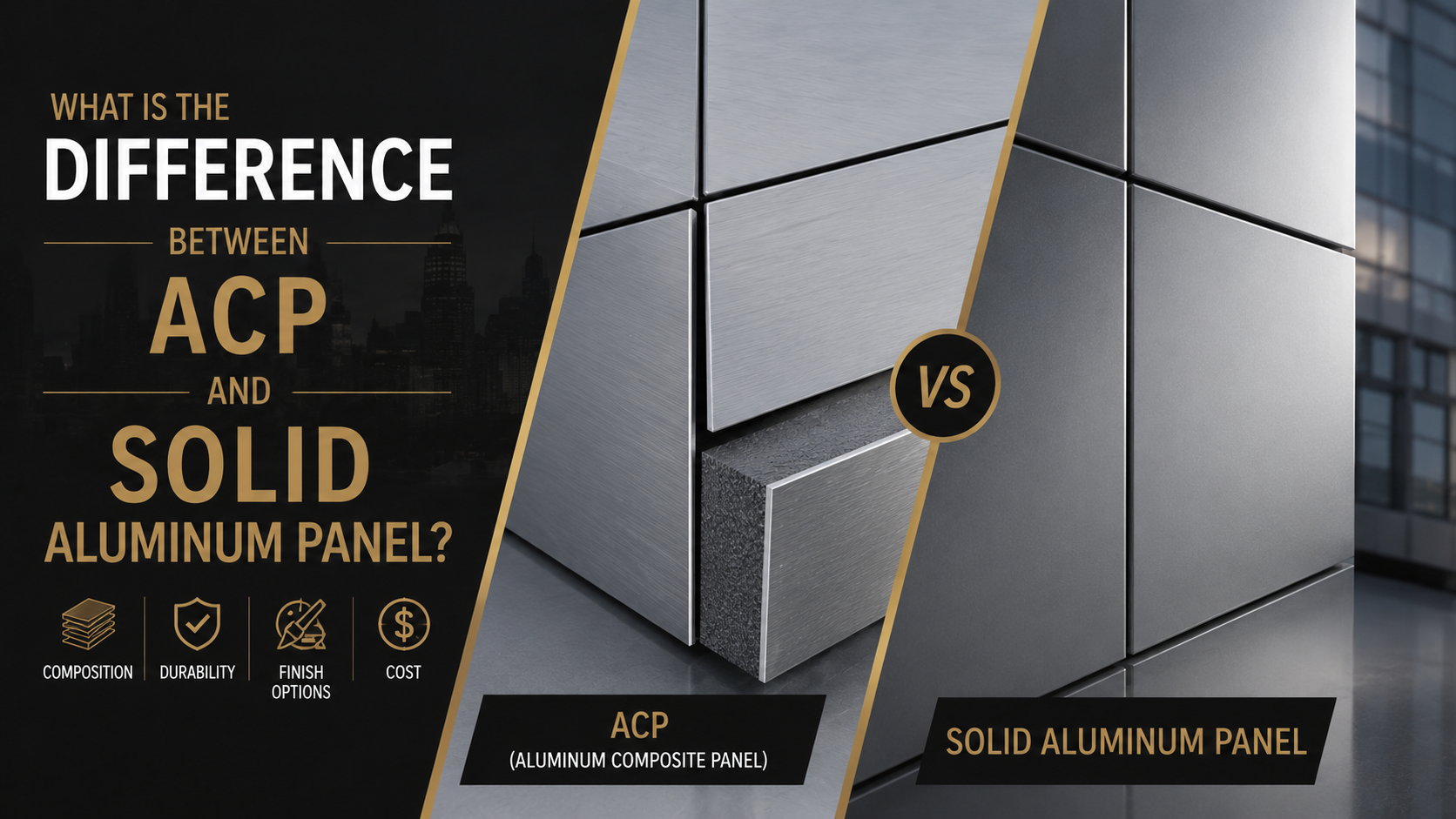
What Is the Difference Between ACP and Solid Aluminum Panel
What is an ACP panel?
An aluminum composite panel (ACP) is a sandwich board built from two thin aluminum skins bonded to a non-metal core. Each skin usually measures 0.5 mm, and the finished board arrives at 3 mm, 4 mm, or 6 mm total thickness. The core is polyethylene, a mineral-filled fire-retardant compound, or a limited-combustible mineral blend. ASTM International governs the bond quality of these boards through ASTM D1781, the climbing drum peel test.
The North American industry also calls this product metal composite material, or MCM. Both names describe one build: a laminated skin-core-skin sheet supplied with a factory-applied coil finish. Panel makers ship the sheets flat, and a fabricator converts them into finished panels on site or in a shop. Stock widths of 50 inches and 62 inches dominate the United States market.
What is a solid aluminum panel?
A solid aluminum panel is a single sheet of aluminum alloy with no core and no lamination. Architectural versions run from 0.080 inch to 0.125 inch thick, and ASTM B209 sets the specification for aluminum sheet and plate. Alloy 3003-H14 handles most formed panels, and 5005-H34 is the standard choice when the finish will be anodized. Aluminum has a density of 2.70 grams per cubic centimeter, so the panel outweighs a composite of matching thickness.
The Aluminum Association draws a hard line between sheet and plate. Sheet covers material from 0.006 inch to 0.249 inch, and plate starts at 0.250 inch. Most products sold as plate panels at 1/8 inch are therefore heavy sheet under that definition. The distinction matters when a specification calls out plate by thickness rather than by product name.
Which criteria separate the two panel types?
Criteria that separate an ACP panel from a solid aluminum panel come down to six practical points. Finish settles the argument fastest. Anodizing is an electrochemical treatment applied to bare aluminum, and a laminated composite cannot run through that bath as a finished panel. A specification calling for a Class I anodic coating at 0.7 mil under AAMA 611, published by the American Architectural Manufacturers Association, points straight to solid aluminum.
Paint puts the two materials on equal footing. Both accept PVDF (polyvinylidene fluoride) coil coating, and the AAMA 2605 grade requires ten-year South Florida exposure testing before a finish qualifies. Composite sheets also carry print graphics and film laminates that a brake-formed sheet holds less cleanly. The remaining criteria sit in the list below.
- Core construction and the fuel it adds to a wall assembly
- Panel weight per square foot and the load it places on framing
- Flatness across wide modules, where visible waviness is called oil canning
- Finish range, since only one of the two accepts anodizing
- Fabrication method, including routing, folding, and back stiffeners
- Repair path after impact damage on an occupied building
ACP and solid aluminum panel comparison table
The comparison table below sets the two panel types side by side on the criteria that drive most specifications. A 4 mm composite with a polyethylene core weighs about 5.5 kilograms per square meter, and 3 mm solid aluminum weighs about 8.6 kilograms per square meter. Figures describe typical architectural products rather than any single manufacturer line.
| Criterion | ACP panel | Solid aluminum panel |
| Build | Two aluminum skins bonded to a core | One aluminum sheet, no core |
| Common thickness | 3 mm, 4 mm, 6 mm | 0.080 in, 0.125 in |
| Weight per square meter | About 5.5 kg at 4 mm with a polyethylene core | About 8.6 kg at 3 mm |
| Core combustibility | Set by the core: polyethylene, fire-retardant, or mineral | None, no core present |
| Finish options | Coil paint, print graphics, film laminate | Coil paint plus anodizing |
| Flatness on wide modules | High, the sandwich resists waviness | Needs back stiffeners |
| Fabrication | Route and return into a folded tray | Brake forming with bonded or welded stiffeners |
| Dent repair | Usually panel replacement | Often dressed out and refinished |
| Typical use | Large cladding fields, signage, column covers | Feature walls, soffits, high-contact zones, anodized designs |
How does fire performance differ between the two?
Fire performance is the sharpest difference between the two panel types. Solid aluminum carries no combustible core, so it adds no fuel to a wall assembly. Aluminum melts near 660 degrees Celsius, and melting is not the same as burning. An ACP panel behaves according to its core, and the three core families perform very differently.
Polyethylene cores burn. Mineral-filled fire-retardant cores slow flame spread, and limited-combustible cores reach class A2-s1,d0 under the European classification standard EN 13501-1. England banned combustible materials in the external walls of residential buildings above 18 meters in 2018, after the Grenfell Tower fire in London. United States practice runs through the International Building Code. The code restricts metal composite material above 40 feet unless the wall assembly has passed NFPA 285, a National Fire Protection Association test.
NFPA 285 evaluates an assembly, not a panel. A fire-retardant core alone does not create compliance, because the listing covers the insulation, the air barrier, the framing, and the panel together. Two buildings using the same panel can land on opposite sides of the requirement when the wall behind it changes. New Jersey enforces this path through its Uniform Construction Code, which adopts the International Building Code.
Which panel stays flatter across a large facade?
Flatness favors the ACP panel on wide modules. The bonded sandwich behaves like a stiff beam, so a 4 mm composite holds a flat face across spans where a bare sheet ripples. Oil canning describes that visible waviness, and the Metal Construction Association treats it as an aesthetic condition rather than a structural defect. Light angle, panel color, and gloss level all change how visible it looks.
Solid aluminum panels reach the same flatness with added parts. Fabricators bond or weld hat channels and stiffener bars to the back face, then set the panel into a rainscreen, a drained and back-ventilated wall cavity. Stiffener spacing tightens as the module grows wider. Those parts add labor, weight, and shop time that a composite tray does not need.
How do fabrication and installation differ?
Fabrication starts from opposite points for the two panel types. An ACP panel is routed and returned: the fabricator cuts a V-groove into the back skin, folds the edges, and adds corner brackets. Solid aluminum is brake-formed, so the return is a bend in the same metal with no exposed core. Both then hang on clips, cassettes, or a carrier frame.
Route-and-return leaves a thin bridge of core material at every fold. Sealing that edge keeps water away from the bond line and lowers the risk of delamination, the separation of a skin from the core. Regional fabricators such as Vision Art Aluminium supply acp panel systems for cladding, signage, and facade work across New Jersey and New York. Solid panels skip that detail entirely, which is one reason they appear at entries and other zones that take contact.
Thermal movement is identical for both. Aluminum expands at roughly 23 micrometers per meter for each degree Celsius, and the skins govern that behavior on a composite. Joint widths therefore calculate the same way for either panel. A composite build buys stiffness, not tighter joints.
Common misconceptions about ACP and solid aluminum
Misconceptions about these two panel types surface in early design meetings and in bid documents. Four repeat most often.
- Aluminum skins do not make a panel non-combustible, because the core carries the fire behavior.
- ACP and MCM are not two products, they are two names for the same laminated build.
- Solid aluminum does not resist oil canning better than composite, it is more prone to it.
- A heavier gauge alone does not guarantee a flat face, since attachment and framing control the result.
Which panel should you choose for your project?
Choice between the two panels follows four findings from the sections above. Weight and flatness favor the composite: a 4 mm ACP panel weighs roughly a third less than 3 mm solid aluminum and holds its face without back framing. Fire classification favors solid aluminum, which has no core to rate and no assembly test attached to the panel itself.
Finish and repair split the decision the other way. Anodized designs and high-contact areas point to solid aluminum, because a dent can be dressed out instead of replaced. Large cladding fields, signage, and long runs of one color point to the ACP panel. Building height and construction type decide the rest, since code limits apply to the assembly rather than to the panel alone.
This content is for informational purposes only and is not a code compliance review. Fire classifications, height limits, and assembly listings change by jurisdiction and by code cycle. Confirm current requirements with the local building department and the panel manufacturer before specifying a cladding system.
Frequently Asked Questions
Is an ACP panel or a solid aluminum panel better?
The better panel depends on building height, specified finish, and impact exposure rather than on material quality alone. An ACP panel wins on weight, flatness, and cost across large fields. A solid aluminum panel wins on finish range, dent repair, and core-free fire classification. Code path usually settles the question before aesthetics do.
What are the key differences between ACP and solid aluminum?
The key difference is construction: an ACP panel bonds two thin aluminum skins to a core, while a solid panel is one sheet of alloy. That single difference drives weight, fire classification, finish options, and repair method. Composite panels stay flat without stiffeners. Solid panels accept anodizing and tolerate dents without full replacement.
Which one costs less?
Composite panels usually cost less per square foot in material, since the build uses two thin skins instead of one thick sheet. Installed cost narrows the gap, because fire-retardant and mineral cores raise panel price while solid panels add stiffener labor. Building height and the required assembly listing shift totals more than material choice alone.
Which panel suits signage and column covers better?
Signage and column covers suit the ACP panel, because the sandwich holds a flat face across wide unbroken surfaces and carries print and film finishes. A 3 mm thickness covers most sign faces, and 4 mm serves column covers and canopy fascia. Solid aluminum remains the choice where impact damage is likely.
When should you pick solid aluminum instead?
Solid aluminum fits three situations. Anodized finishes require bare aluminum, so a laminated composite is ruled out. High-contact areas such as entries, ground-level walls, and parking structures benefit from a panel that can be dressed out after a dent. Walls that cannot meet a combustible-core requirement also default to solid metal.