

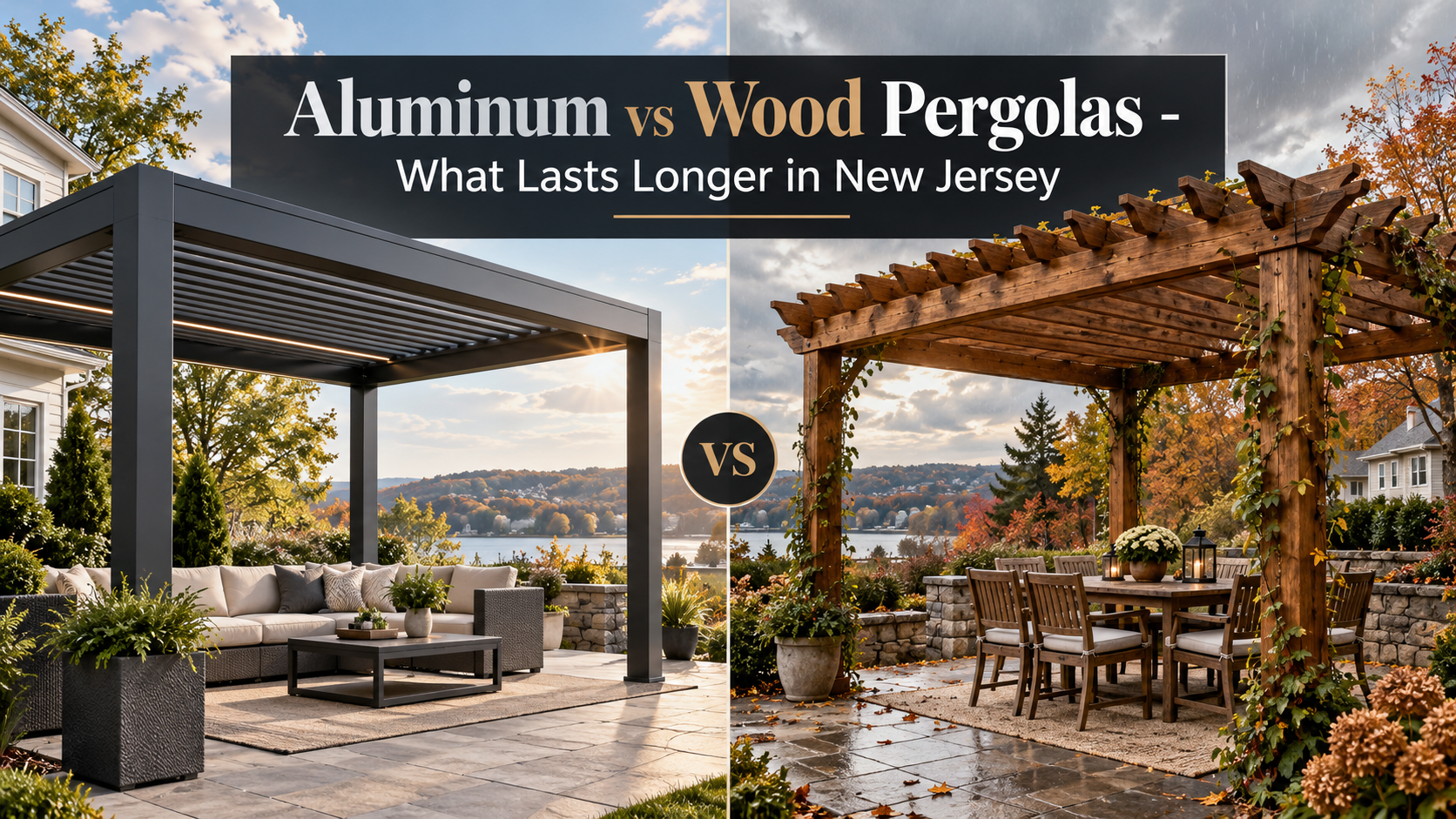
Aluminum vs Wood Pergolas – What Lasts Longer in New Jersey
In the aluminum vs wood pergola comparison under New Jersey conditions, aluminum lasts longer by a wide margin: a powder coated aluminum frame holds its geometry and its finish for decades with little more than seasonal rinsing, while a wood pergola asks for sanding and resealing every few years and still reaches the end of its useful life first.
The gap between the two materials is wider here than it would be in a dry western climate. New Jersey gives a structure humid summers, a long autumn of wet leaves sitting on horizontal surfaces, then a winter that crosses the freezing point over and over instead of settling below it.
What the New Jersey Climate Does to Each Material
Five exposures do almost all of the damage in this state.
- Freeze thaw cycling. Water works into the end grain and into surface checks, expands when it freezes, and opens the check a little wider. Next thaw, that wider gap holds more water. This is the mechanism that ages a wood pergola faster than a homeowner expects, and it runs dozens of times between November and March. Aluminum absorbs no water, so the cycle has nothing to act on.
- Humid summers. Sustained humidity feeds rot and mildew where water lingers: post bases, the top faces of beams, and the joints where two boards meet. Aluminum can grow surface film in the same spots, but it washes off rather than eating into the material.
- Salt air. Along Monmouth, Ocean, Atlantic and Cape May counties, airborne salt strips coatings faster and corrodes steel fasteners inside a wood frame, which is usually where a shore structure fails first. Aluminum forms a protective oxide layer and does not rust, though a marine appropriate coating and stainless hardware still matter near the water.
- UV exposure. Ultraviolet light breaks down the surface layer of unprotected wood, which is what turns it grey and chalky before any structural loss shows. A quality powder coat fades slowly and evenly.
- Wind loading. Nor’easter gusts test connections rather than spans. On a wood pergola the weak point is typically the post base and the fastener that has been quietly corroding inside a damp joint. This is one reason aluminum pergolas in New Jersey are built as engineered systems with the snow and wind case worked out for the site rather than assembled from stock lumber sizes.
Service Life Ranges and the Variables That Move Them
Species, lumber grade, the quality of the original finish, whether the posts sit in standing water, and how exposed the yard is all move a structure to one end of its range or the other.
A pressure treated pine pergola commonly serves ten to fifteen years. Kept sealed on schedule and set on proper standoff bases, it can pass that. Left to weather, with post bottoms in contact with wet soil or a puddling slab, it can be structurally questionable well before year ten. Cedar and redwood behave better, roughly fifteen to twenty five years, because the natural oils resist rot, though they still grey and still lose surface integrity without a finish.
Powder coated aluminum sits in a different category because its failure modes are not decay. The structure does not rot, swell, split or feed insects, so what ages is the coating and, on motorized systems, the moving components. Decades of service is a reasonable expectation.
Warranty behavior follows the same logic. Coverage on aluminum systems is generally written around the finish and the operating parts. Coverage on treated lumber tends to address rot and insect attack in the treatment itself, not the checking, warping and greying that actually drive replacement, and it usually depends on the owner keeping up documented maintenance.
The Aluminum vs Wood Pergola Cost Picture Over Ten Years
The figures below assume a roughly 12 by 16 foot attached structure and are indicative New Jersey ranges that shift with size, site access, footing work and finish level. Motorized louvered and retractable systems sit above this band because they include a mechanism, drainage and controls.
Ten year cost element | Powder coated aluminum | Pressure treated pine | Cedar or redwood | Vinyl |
Typical installed cost | $8000 to $18000 | $4000 to $9000 | $7000 to $15000 | $5000 to $12000 |
Refinishing cycle | None | Every 2 to 3 years | Every 2 to 4 years | None |
Refinishing over ten years (DIY materials up to contracted labor) | $0 | $600 to $5000 | $600 to $5000 | $0 |
Cleaning and hardware upkeep over ten years | $100 to $500 | $200 to $600 | $200 to $600 | $150 to $500 |
Likely repair by year ten | Rare and usually cosmetic or a moving part | Post base rot, split beams, corroded fasteners | Occasional board replacement | Cracked or sagging sections and UV chalking |
Indicative ten year total | $8100 to $18500 | $4800 to $14600 | $7800 to $20600 | $5150 to $12500 |
Condition entering year eleven | Essentially as installed | Often near the end of useful life | Sound if maintained | Serviceable with reduced color and stiffness |
The lines cross somewhere between year six and year ten for anyone paying a contractor to refinish. A pressure treated structure bought at the bottom of its range can meet the bottom of the aluminum range by year ten, and it arrives there worn out while the aluminum arrives unchanged. A homeowner doing the refinishing personally keeps wood cheaper in cash terms across the decade, but the cost has simply moved from the invoice to the weekend.
Where Vinyl Lands Between the Two
The aluminum vs vinyl pergola question usually comes up as a way to skip maintenance without paying for metal, and it half works. Vinyl needs no staining and does not rot, so the recurring spend genuinely drops. Vinyl loses rigidity in heat and becomes more brittle in deep cold, which is why vinyl pergola members are often sleeves over an internal frame and why spans stay short. Long term, UV tends to chalk and yellow the surface, and unlike a coated aluminum profile a discolored vinyl member is not easily refinished. For a small shaded structure it is a reasonable middle option. For a wide span over an exposed patio in a shore county, it is the weakest of the three.
The Autumn Split: One Structure Needs Work Before the Frost
A wood pergola carries a hard deadline every autumn, because sealing and staining products need surface temperatures above their minimum to cure properly. Miss the window and the structure enters winter with an open surface, which is precisely when freeze thaw does its most efficient damage.
An aluminum pergola has no equivalent obligation. On a rotating blade system such as the aluminum louvered pergola Sky Blade , the roof closes into a sealed plane and the integrated drainage carries water off the patio, so the space stays usable through cold rain instead of being surrendered in October.
What Are the Pros and Cons of a Pergola
A pergola gives you a defined outdoor room without the cost, permitting weight or structural commitment of an enclosed addition, and on an adjustable roof it lets you dial the conditions instead of accepting one fixed level of shade. It anchors a flat yard visually and extends the usable season at both ends.
Open sides mean wind driven rain and insects unless you add screens or panels. A fixed slat roof, wood or aluminum, offers no meaningful rain protection at all. Setback and permit rules apply, and they vary by municipality. A motorized system adds mechanical parts, a power connection and an eventual service need. And a pergola does not add conditioned square footage, so it is an amenity rather than an extension of the house.
When Wood Is Still the Better Choice
On a historic or strongly period property, an extruded aluminum profile can read as wrong next to original detailing, and a painted timber structure is the only material that sits correctly. Heavy rough sawn timber has a mass and grain that aluminum does not imitate convincingly, and for a rustic or wooded setting that look is the entire point. If the budget only reaches the lower band today, a cedar structure built now beats an aluminum one deferred indefinitely.
Questions Homeowners Ask About Pergola Materials
How often does a wood pergola need to be resealed in New Jersey?
Most wood pergolas here need attention every two to three years, with cedar sometimes stretching to four. Horizontal top surfaces and post bases wear faster than vertical faces because water sits on them, so those areas often need a touch up between full cycles. Exposure is the variable that matters most: a structure in full afternoon sun near the shore will need it sooner than one under partial tree cover inland.
Does an aluminum pergola get too hot to sit under?
No, because the frame is not what you feel. Aluminum conducts heat quickly, so a sun exposed beam warms to the touch, but the comfort under the structure comes from shade and airflow rather than from the material temperature. A louvered roof actually improves on this by letting you angle the blades to block direct sun while keeping hot air moving out from underneath.
Is aluminum or vinyl better for a house near the shore?
Aluminum, clearly, once salt air and wind are in the picture. Aluminum does not rust and holds a marine appropriate coating well, while vinyl’s weakness in an exposed coastal yard is mechanical rather than chemical: less rigidity across a span and more brittleness in cold.
Can an aluminum pergola handle snow and nor’easter wind?
Yes, when the system is engineered for the site rather than sold as a generic kit. The load case that matters in New Jersey is a closed roof carrying wet snow while a nor’easter pushes laterally on the posts, and that is a question of member sizing, connection design and footing detail. Ask what snow and wind loading a proposed system is rated for at your address before comparing prices.