

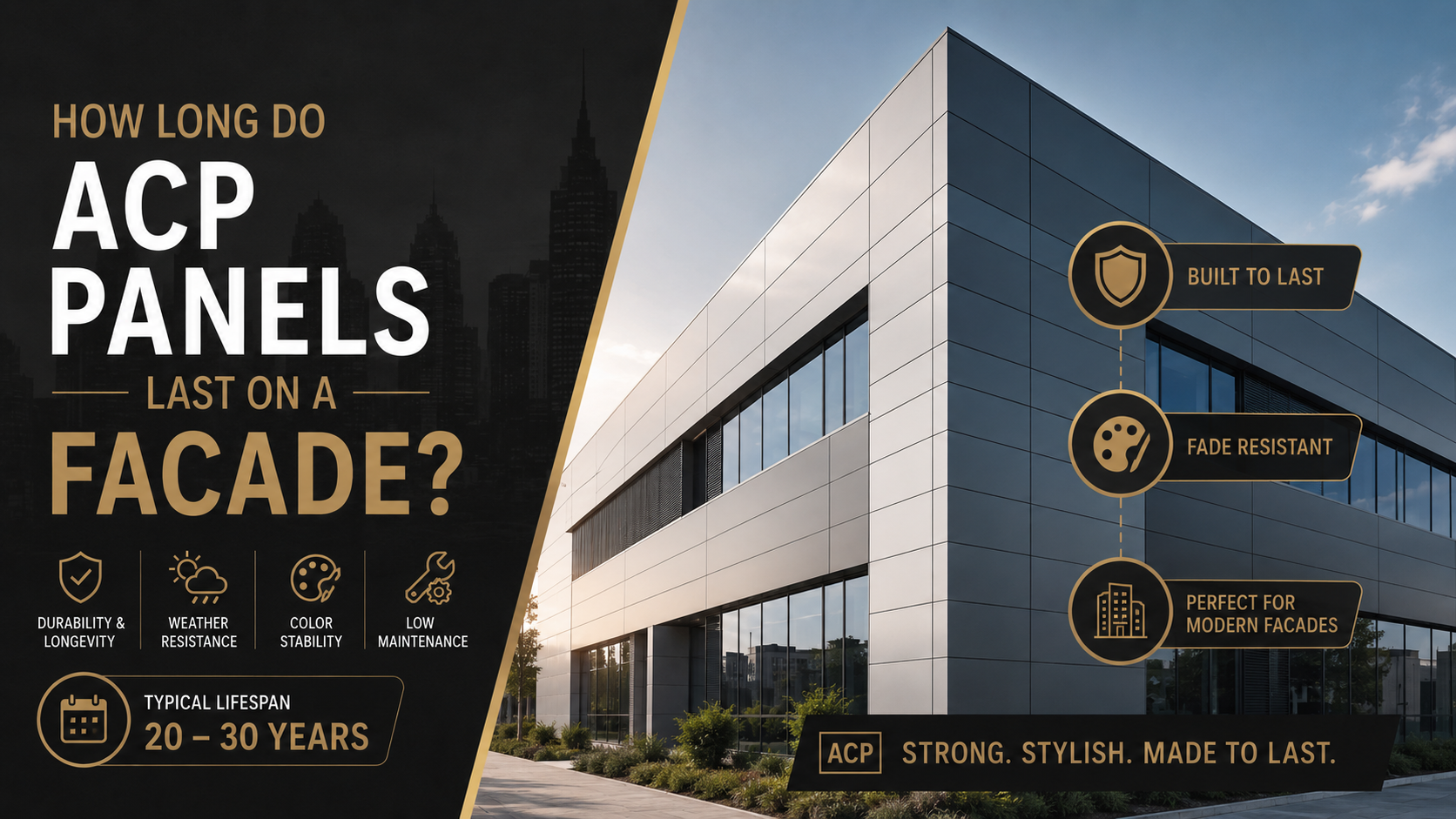
How Long Do ACP Panels Last on a Facade
What is an ACP panel?
An ACP panel (aluminum composite panel) is a cladding sheet built from two thin aluminum skins bonded to a solid core. Each skin usually measures 0.5 mm, and finished panels come in 3 mm, 4 mm, and 6 mm thicknesses. The core is polyethylene, a mineral-filled fire-retardant compound, or a high-mineral A2 grade. The International Code Council lists the product as metal composite material (MCM) in the International Building Code.
The panel is a sandwich, so its service life is really three service lives. The aluminum skin resists corrosion behind a natural oxide layer that reforms whenever it is scratched. The factory coating carries the color and blocks ultraviolet light. The adhesive film holds skin and core together through every heat cycle and wind load.
How long do ACP panels last on a facade?
ACP panels stay in service on a facade for 25 to 40 years when the finish is a fluoropolymer coating and the wall drains water. The coating sets the practical ceiling, not the metal. Panels finished with standard polyester paint fade visibly far sooner, often inside 10 years on sun-exposed elevations. Aluminum does not rust, so a stripped panel can outlive its own color by decades.
Service life for an aluminium acp system splits into two questions that owners often merge into one. The first asks how long the panel stays watertight and structurally sound. The second asks how long it still looks acceptable beside a new panel. Aesthetic life ends first on almost every building, and it ends unevenly from elevation to elevation.
What determines the coating life of an ACP facade?
Coating chemistry explains most of the gap between a 10-year finish and a 30-year finish. Facade coatings sit in three performance tiers published by the Fenestration and Glazing Industry Alliance, formerly the American Architectural Manufacturers Association. Each tier is defined by how long a test panel survives outdoor exposure in South Florida. AAMA 2605 sits at the top with a 10-year exposure requirement.
| Specification | Coating type | South Florida exposure | Typical facade behavior |
| AAMA 2603 | Polyester | 1 year | Interior use, signage, short-life exterior |
| AAMA 2604 | Modified polyester or 50 percent fluoropolymer | 5 years | Mid-life exterior with moderate fade |
| AAMA 2605 | 70 percent PVDF fluoropolymer | 10 years | Long-life facade, slow chalk and fade |
PVDF (polyvinylidene fluoride) is the resin behind the top tier, blended at 70 percent of the coating binder. The specification also sets laboratory floors: 4,000 hours of humidity resistance and 4,000 hours of salt spray under ASTM International methods. Color change is capped at 5Delta E units, a numeric measure of visible color shift. Chalk rating, which scores the loose pigment powder a weathered coating sheds, must stay at 8 or better.
What do ACP facade warranties actually cover?
ACP facade warranties arrive as two separate documents, and building owners frequently read only one. The coating warranty covers film integrity, chalking, and color change, and it commonly runs 20 to 30 years. The panel warranty covers bond integrity between skin and core, and it usually runs shorter. Neither document covers sealant joints, fasteners, or the substructure behind the panel.
Coverage narrows in ways that matter along the New Jersey and New York coastline. Many coating warranties carry a marine exclusion for buildings near salt water unless a coastal rider is added. Warranties also exclude damage from alkaline or abrasive cleaners, so one aggressive wash can end coverage. Terms are pro-rated as well, so the payout falls every year the facade stays up.
Why does color fade on an ACP facade?
Color fade on an ACP facade begins when ultraviolet radiation breaks the bond between pigment and resin. The resin surface erodes and releases loose pigment, the powdery effect that chalk rating measures. Deep colors and saturated reds fade fastest because their pigments absorb more energy. Metallic and mica finishes shift differently, since flake orientation changes how light returns to the eye.
Fade is never uniform across a building. South and west elevations in the New York metropolitan area take the heaviest daily sun load and age ahead of north-facing panels. That gap creates a planning problem: a replacement panel matched to the original color chip will not match a fifteen-year-old neighbor. Owners therefore schedule replacement by elevation rather than panel by panel.
What causes delamination in composite panels?
Delamination is the separation of an aluminum skin from the core, and it is the failure that ends a panel’s structural life. Water reaching the core through an unsealed cut edge is the most common trigger. Fabricators expose the core every time they rout a groove for a fold, so shop edge sealing is decisive. Blisters, a rippled surface, and a hollow sound under tapping are the early field signs.
Thermal cycling drives the second mechanism. Aluminum expands and contracts roughly twice as much as the steel substructure it hangs on, and dark panels run far hotter than surrounding air. Fixings that block that movement push stress straight into the adhesive film. Peel strength, the force needed to pull a skin off the core, is the laboratory measure of that bond.
Which maintenance steps extend ACP facade life?
Maintenance for an ACP facade is short, repetitive, and mostly about water and pH. Twice per year is the common washing baseline, and buildings near highways or salt water move to quarterly cleaning. Crews use pH-neutral detergent, soft cloths or soft brushes, and clean rinse water. Solvents, abrasive pads, and close-range pressure washing all cut into the coating film.
- Washing with a pH-neutral detergent, rinsed from the top down.
- Sealant joint inspection for splits, chalky residue, and lost adhesion.
- Drainage checks that keep weep holes and the cavity behind the panel clear.
- Visual scans for blisters, edge lifting, and hollow sound on tapped panels.
- Fastener review for white powder deposits or rust staining at the clips.
- Annual photographs of the south and west elevations to track color shift.
Sealant reaches end of life before the panel does on most facades. Wet-sealed silicone joints typically need replacement at 10 to 20 years, well inside the panel’s own service window. A rainscreen hangs panels over a drained and ventilated cavity, commonly 3/4 inch to 2 inches deep, so water exits instead of loading a bead of sealant. Vision Art Aluminium settles the joint method and the edge treatment at drawing stage, and aluminium acp service life is largely fixed at that point. Fastener isolation belongs in the same drawing set, because aluminum in contact with steel or copper starts galvanic corrosion.
Common misconceptions about ACP panel lifespan
Misconceptions about ACP panel lifespan usually start with the word aluminum. The metal does not corrode the way steel does, so owners assume the whole assembly is maintenance free. Field failures on an aluminium acp facade follow a different pattern, and they cluster around coatings, joints, and fixings. The claims below surface in most facade conversations.
- Claim: aluminum does not rust, so the facade needs no upkeep. Coating, sealant, and fixings each age on their own schedule.
- Claim: a thicker panel lasts longer. Thickness governs flatness and wind performance, not coating durability.
- Claim: a fire-rated core also improves weathering. Core grade governs fire behavior, not fade resistance or bond strength.
- Claim: a faded facade has to be replaced. Field recoating exists, though its warranty runs shorter than a factory finish.
- Claim: the warranty covers the whole facade. Coating and panel warranties exclude sealant, fasteners, and workmanship.
What decides whether an ACP facade reaches 30 years?
An ACP facade reaches 30 years when four decisions line up early, and none of them happen on the scaffold. Coating specification comes first: an AAMA 2605 fluoropolymer finish carries ten times the outdoor exposure requirement of an AAMA 2603 polyester. Edge sealing and drainage come second: a routed fold left open at the shop shortens panel life whatever the coating grade.
Maintenance discipline is the third factor, and it costs little against replacement. Two neutral-detergent washes a year protect both the finish and the warranty. Elevation planning is the fourth: owners who log color on the south and west faces each year can budget replacement section by section. The panel rarely fails as a material, and the assembly around it usually sets the date.
This content is general information about facade materials and is not a substitute for a project-specific engineering assessment. Product specifications, coating grades, and warranty terms differ by manufacturer and by local building code. Verify current details with the manufacturer and the authority having jurisdiction before specifying a system.
Frequently Asked Questions
How long do ACP panels last on a facade?
ACP panels last 25 to 40 years on a facade when they carry a 70 percent PVDF coating and hang over a drained cavity. Polyester-finished panels fade much sooner, often within a decade on sunlit elevations. The aluminum skin outlives the finish, so color, sealant, and fixings normally decide the replacement date.
What causes ACP panels to delaminate?
Delamination happens when an aluminum skin separates from the core, usually after water enters through an unsealed cut edge. Thermal movement adds stress whenever fixings block expansion, and dark panels on sun-facing walls cycle hardest. Blisters, ripples, and a hollow sound under tapping are the earliest field signs of a failing bond.
Does an ACP warranty cover fading?
Coating warranties cover fading, chalking, and film integrity, and fluoropolymer finishes commonly carry 20 to 30 years. Coverage is pro-rated, so the payout drops each year. Panel warranties are separate documents and address bond integrity between skin and core. Neither covers sealant joints, fasteners, substructure, or damage from abrasive and alkaline cleaning.
How often should an ACP facade be cleaned?
Twice a year is the standard cleaning interval for an ACP facade in a suburban setting. Buildings near highways, industrial sites, or salt water move to quarterly washing. Crews use pH-neutral detergent, soft brushes, and clean rinse water applied from the top down. Solvents, abrasive pads, and close-range pressure washing damage the coating film.
Can a faded ACP facade be recoated instead of replaced?
A faded ACP facade can be field recoated through cleaning, priming, and spray application of an air-dry fluoropolymer or acrylic finish. Field coatings do not match the durability of a factory-baked PVDF film, and their warranties run shorter. Recoating suits sound panels, while delaminated, dented, or water-damaged panels still need replacement.