

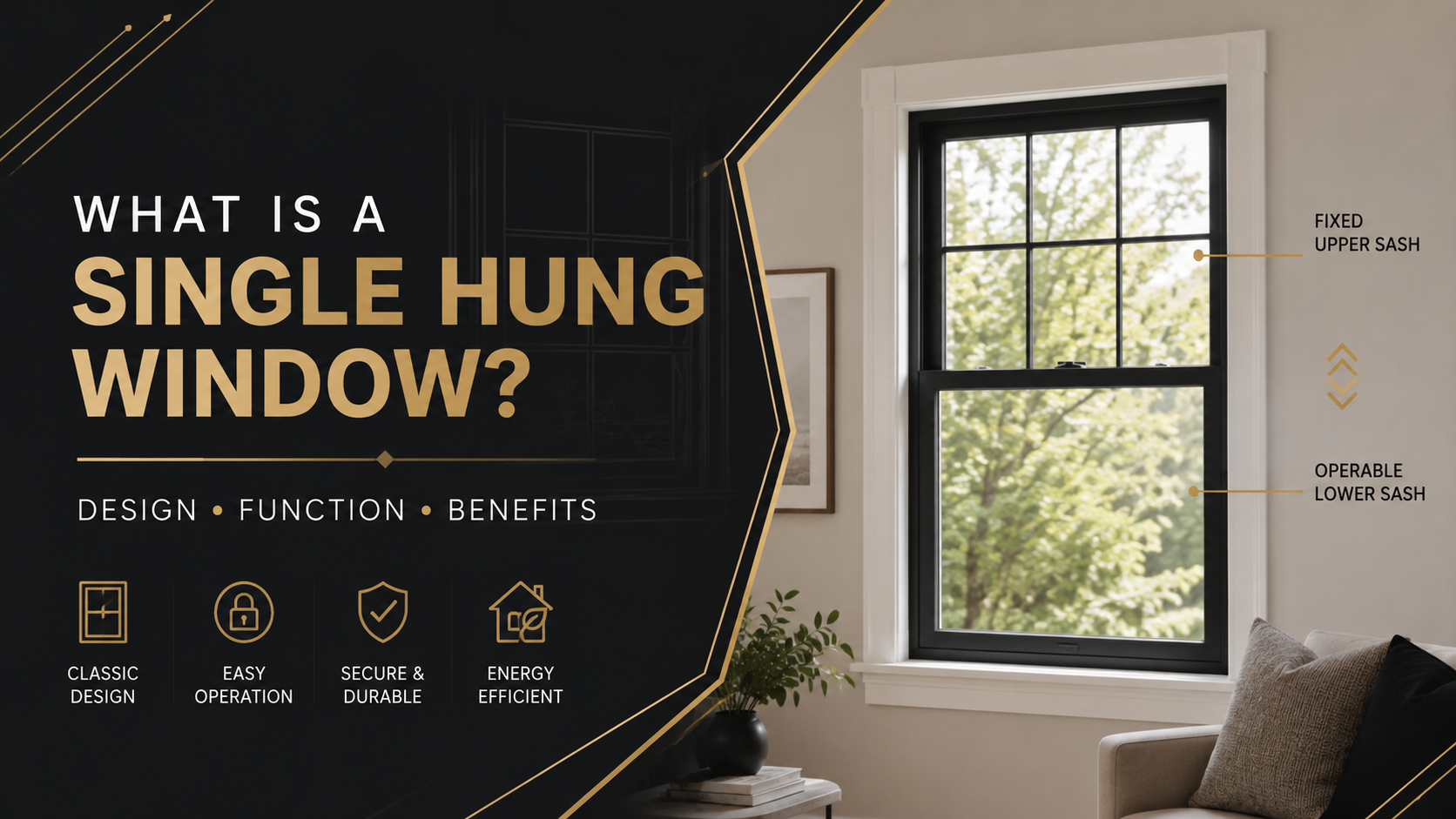
What Is a Single Hung Window?
A single hung window is a vertical window with two panels, where the upper panel stays fixed and only the lower panel slides up and down. Each panel is a sash, the framed section that holds the glass. This design gives the window one operable opening at the bottom and one sealed panel at the top. Single hung windows rank among the most common residential window styles across New Jersey and New York homes.
Vision Art Aluminium, a premium aluminum systems manufacturer at 28 Valley Road in Montclair, New Jersey, builds single hung windows as part of its residential and commercial line. The company serves New Jersey and New York, covering design, permitting, manufacturing, and installation. Its single hung units belong to the HR4 and HRW4 series, engineered for high structural load and severe weather.
How does a single hung window operate?
A single hung window operates through one moving sash at the bottom of the frame. The homeowner lifts the lower sash upward to open the window, and it slides along vertical tracks inside the frame. The upper sash stays fixed and never moves. Because only one sash travels, the mechanism uses fewer moving parts than windows with two operable sashes.
The fixed upper sash creates a permanently sealed section at the top of the window. This sealed panel reduces the number of gaps where air and water can enter. Many single hung windows use a balance system, a spring mechanism hidden in the frame that holds the lower sash at any height. The balance system lets the sash stay open without a separate prop.
Single hung vs double hung windows: what is the difference?
The core difference is that a double hung window moves both sashes, while a single hung window moves only the bottom sash. In a double hung unit, the top and bottom sashes slide vertically, and many tilt inward for cleaning. A single hung unit keeps the top sash fixed, so cleaning the exterior of the upper glass usually requires outside access. Fewer moving parts also means fewer seams where air can leak.
| Feature | Single hung window | Double hung window |
| Movable sashes | One (bottom only) | Two (top and bottom) |
| Fixed sash | Top sash | None |
| Air infiltration points | Fewer | More |
| Exterior cleaning from inside | Limited | Easier, tilt-in |
| Moving parts | Fewer | More |
The single hung design suits buyers who want a simpler, tighter seal and a lower count of mechanical parts. The double hung design suits buyers who prioritize easy interior cleaning of both panes. Both styles share the same outward vertical look, so the choice usually turns on ventilation and maintenance needs rather than appearance.
What does design pressure mean?
Design pressure, often written as DP, measures the wind load a window can withstand before it fails. Engineers rate design pressure in pounds per square foot (psf), the force of wind pushing against or pulling away from the glass. A positive number rates the pressure pushing the window inward, and a negative number rates the suction pulling it outward. Higher numbers mean the window resists stronger wind.
The Vision Art Aluminium single hung window carries a design load of +70/-80 psf. The positive 70 psf rating covers wind pushing directly against the window, and the negative 80 psf rating covers the suction force during a storm. This rating places the HR4 and HRW4 series in the range built for high-wind and hurricane exposure zones.
Why does a thermal break matter?
A thermal break is an insulating barrier placed inside the aluminum frame to slow heat transfer. Aluminum conducts heat and cold quickly, so an uninsulated frame lets outdoor temperatures pass straight into the home. The thermal break, a strip of low-conductivity material, separates the interior metal from the exterior metal. This separation reduces energy loss and limits condensation on the frame.
The Vision Art Aluminium single hung window uses a thermal break of 9/16 inch. This barrier sits between the inner and outer aluminum profiles of the frame. A wider thermal break generally improves the frame’s resistance to heat flow. That resistance supports indoor comfort during New Jersey winters and New York summers and helps hold energy costs down.
What makes the Vision Art single hung window hurricane resistant?
The Vision Art Aluminium single hung window resists hurricanes through impact-rated glass and a high design load. The HR4 and HRW4 series hold Miami-Dade and Florida approval, the certification path for high-velocity hurricane zones. These units use laminated glass and insulated glass, which bond and layer the panes to resist impact. The Vision Art single hung window pairs this glazing with a +70/-80 psf design load.
Laminated glass holds together when struck, because a plastic interlayer bonds the panes. Insulated glass uses two panes with a sealed gap that improves thermal performance. Miami-Dade approval, named for the Florida county with one of the strictest building codes in the United States, signals that a product passed impact and pressure testing. Windows carrying this approval are engineered for coastal and storm-prone conditions.
Which window types does the platform support?
The Vision Art Aluminium single hung platform supports four operating types built on the same HR4 and HRW4 engineering. Each type shares the hurricane-rated construction but opens in a different way. This lets one product family cover a range of openings across a home or building.
- Single hung: a fixed upper sash with a movable lower sash that slides vertically.
- Casement: a sash hinged on the side that swings outward like a door.
- Fixed: a non-operable window that never opens, built for light and views.
- Sliding: a sash that glides horizontally along a track.
The shared engineering means each type can carry the same impact rating and thermal break. A single project can mix single hung, casement, fixed, and sliding units while keeping one consistent frame system. This matters for larger builds where different rooms call for different opening styles.
Where a single hung window fits best
A single hung window fits homes and buildings that need a sealed, weather-resistant opening with a clean vertical profile. Its fixed upper sash cuts air infiltration points and lowers the count of moving parts. The Vision Art Aluminium HR4 and HRW4 series add Miami-Dade and Florida approval, a +70/-80 psf design load, and a 9/16 inch thermal break. These features target storm exposure and energy performance. For homes across New Jersey and New York, the single hung style pairs a simple mechanism with hurricane-rated glass.
This content is for informational purposes only. Product specifications, certifications, and ratings can change over time; verify current details with the manufacturer before making a purchase or construction decision.
Frequently Asked Questions
What is a single hung window?
A single hung window is a vertical window with two sashes, where the top sash is fixed and only the bottom sash slides up and down. The fixed upper panel seals the top, and the movable lower panel provides ventilation. This design keeps fewer moving parts and fewer air gaps than a double hung window.
How does a single hung window work?
A single hung window works by lifting the lower sash along vertical tracks inside the frame while the upper sash stays fixed. A hidden balance system, a spring mechanism inside the frame, holds the lower sash at any height. Because only one sash moves, the window uses a simpler mechanism with fewer parts that can wear.
Why does a thermal break matter in a window?
A thermal break matters because aluminum conducts heat quickly, and the barrier slows that transfer through the frame. The Vision Art Aluminium single hung window uses a 9/16 inch thermal break between the inner and outer profiles. This reduces energy loss, limits condensation, and supports indoor comfort through New Jersey winters and New York summers.
What does the design load rating on a window mean?
The design load, or design pressure, states how much wind force a window can withstand, measured in pounds per square foot (psf). The Vision Art Aluminium single hung window carries a +70/-80 psf rating. The positive figure covers wind pushing inward, and the negative figure covers suction pulling outward during a storm.
Is a single hung window suitable for storm-prone areas?
A single hung window is suitable for storm-prone areas when it carries impact-rated glass and a high design load. The Vision Art Aluminium HR4 and HRW4 series hold Miami-Dade and Florida approval, use laminated and insulated glass, and carry a +70/-80 psf design load. These features are engineered for high-velocity hurricane zones and coastal exposure.
Weighing single hung against European alternatives? Compare styles on our aluminum windows page.