

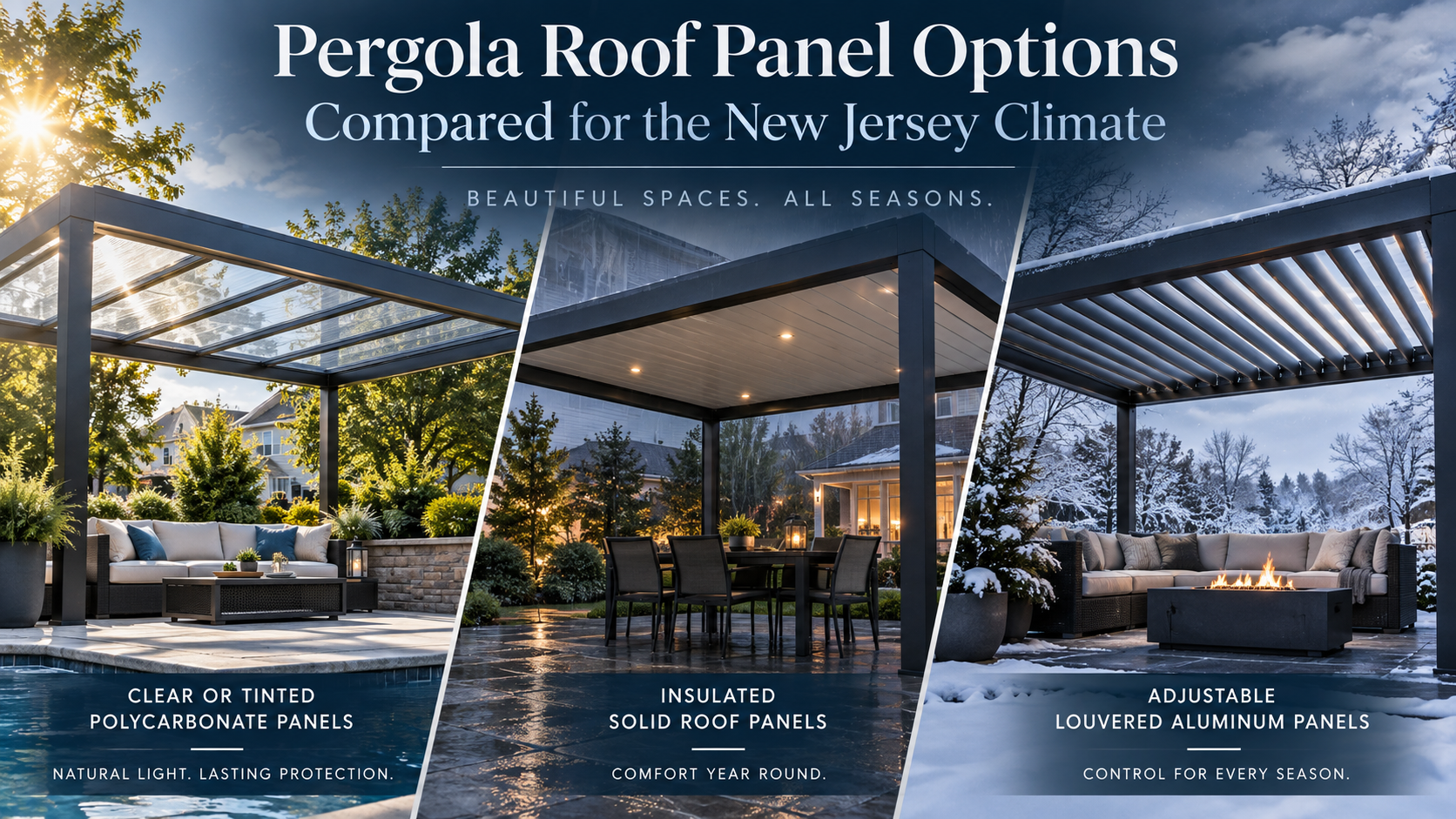
Pergola Roof Panel Options Compared for the New Jersey Climate
A roof that feels perfect on a July afternoon can pond water in an October downpour, sag under wet February snow or turn a quiet patio into a drum during a thunderstorm. Judged across a full New Jersey year instead of one season, pergola roof panels sort into four honest categories: rigid polycarbonate sheets, retractable fabric roofs, rotating aluminum louvers, and fixed solid or insulated aluminum panels.
The four covers you are choosing between
Rigid polycarbonate sheets
Polycarbonate is a translucent plastic sheet, usually multiwall with hollow flutes running along its length, fixed over an aluminum or timber frame. It is the least expensive way to put a rigid waterproof surface over a patio and it passes a lot of daylight.
A hard plastic sheet over an open frame amplifies impact noise, so heavy rain and hail get loud enough to interrupt a conversation underneath. Once the protective surface layer wears, the sheet commonly hazes and yellows under years of direct summer sun. Unsealed flute ends collect dust and algae, which reads from below as dark stripes. Polycarbonate also moves noticeably with temperature, so installations that pin the sheets rigidly tend to creak, elongate their screw holes through repeated freeze thaw cycles and start weeping at the fastener line.
Retractable fabric roofs
A retractable roof runs tensioned fabric across an inclined frame, then pulls it back so the patio opens to the sky. Drainage separates a good version from a bad one. The SkyFlow system handles this with a horizontal gutter profile developed into the front beam, so runoff collects at the low edge and is carried away through a concealed drainage network rather than exposed downspouts.
Fabric is a shade and rain surface, not a load deck, so the winter habit here is to keep the cover retracted or cleared during accumulating snow. The reinforced profiles on this line (Gold Pillar, Gold Rail, Diamond Rail and Diamond Pillar) are engineered for heavy snow loads, rain and other environmental pressure, so the frame stays out in weather the fabric sits out.
Rotating aluminum louvers
A louvered roof is built from aluminum blades turning on a shared axis. Closed, they overlap into a water shedding roof. Open, they filter sun and vent trapped heat straight up. On the Sky Blade system the blades rotate through a range of up to 135 degrees, the gear driven mechanism stays below 40 dB, panels come in blackout or translucent form, and an optional rain sensor closes the roof by itself when the first drops land. Water leaves through a four sided gutter network built into the rails and pillars, so every edge drains rather than only the front.
Gears, motor and pivot points mean the yearly clean out of blade ends and gutter channels matters more than on a fixed roof. Closed blades are a rain shield, not a sealed ceiling, so wind driven rain still arrives from the open sides unless zip screens close the perimeter.
Fixed solid or insulated aluminum panels
A solid aluminum roof, often with an insulated core, sheds water and snow better than anything else here and is the quietest in a downpour because the core absorbs impact instead of resonating. It also removes the sky permanently. Anything that borrowed daylight from that direction, a kitchen window or a set of patio doors, gets darker. Solid roofs also need a committed slope and a real gutter run, since all the water exits at one edge.
What New Jersey weather does to pergola roof panels
Autumn rain and where the water goes
Leaves land on the roof, migrate to the low edge and sit in whatever channel is there. A gutter integrated into the frame moves that water inside the structure and keeps the entry dry, while an uncollected roof drops a curtain of runoff exactly where people walk in and out. Clear every drainage point after the leaves finish dropping and before freezing weather turns a blocked channel into an ice plug.
Snow load and freeze thaw
Snow decides the frame, not the finish. Two local conditions matter: wet snow arriving at temperatures near freezing, and the freeze thaw cycling that follows, where meltwater refreezes at the coldest point of the assembly, usually the drainage edge. A rigid roof holds snow until it slides or is cleared, so span, blade thickness and post spacing carry the day. Polycarbonate punishes an underspecified frame hardest, because a sheet spanning too far between purlins bows under wet snow and stays slightly deformed afterward. Freeze thaw also works on sealant lines, which is why mechanical drainage ages better than a watertight bead.
Summer sun and fading
New Jersey summers deliver enough ultraviolet exposure to age any polymer left in the open. Fabric fades gradually and is a replaceable component, which is worth knowing before buying: the frame outlasts the cover, and re-covering is a normal event rather than a failure. Polycarbonate ages differently, yellowing and growing brittle at the surface, and it is not re-skinnable in the same way, so an aged sheet is usually replaced whole. Powder coated aluminum is the most stable of the group under direct sun.
Comparison at a glance
Roof type | Rain shedding | Snow season | Sun and fading | Rain noise | Light control |
Polycarbonate sheet | Good if sloped and guttered | Frame dependent, sheets can deflect | Hazes and yellows over years | Loudest of the four | Fixed, no adjustment |
Retractable fabric | Good with slope and integrated gutter | Normally retracted during snowfall | Fades gradually, replaceable | Softer than rigid plastic | Fully open or fully covered |
Rotating louvers | Good, closed blades plus perimeter gutters | Sheds when closed, keep channels clear | Powder coated aluminum stays stable | Moderate | Adjustable across the rotation range |
Solid or insulated panel | Best of the four | Sheds well, watch edge ice | Very stable | Quietest | None, permanent shade |
Maintenance and how long each option lasts
- Polycarbonate typically wants two washes a year, sealed flute ends checked annually and fastener grommets inspected after a hard winter.
- Fabric roofs commonly need a rinse before winter storage and a track and tension check in spring. In most installations the fabric is a wear part and the frame is not.
- Louvered roofs usually need blade ends and gutter channels cleared twice a year, plus a motor test cycle before heavy use.
- Solid panels need the least attention, mainly gutter clearing, which is also the task most often forgotten because nothing looks like it needs care.
What is the most affordable way to cover a patio?
The cheapest cover is the one that does the least. From lowest cost upward: a shade sail or open slat roof that filters sun and stops nothing else, then polycarbonate on a basic frame, then a retractable fabric roof on an engineered aluminum structure, then a louvered aluminum roof, with insulated solid panels landing at or above that depending on span.
The order shifts once you count a decade instead of a season. Fabric keeps the entry price lower and adds a known future cost. Polycarbonate has the lowest rigid entry price and the shortest cosmetic life. Louvered and solid aluminum cost the most up front and consume the least afterward. Installation weight counts too: a standard 6 by 4 meter retractable unit assembles in roughly 8 hours across a five step process, so the yard is disrupted for a day rather than a week.
Two systems that answer the same question differently
Choose a retractable roof when the point of the patio is open sky and shade is something you deploy when needed. The aluminum retractable pergola Sky Flow is built around that logic, with 12 design types across three frame configurations (wall mounted, free standing and parasol style), a rear connection anchored to existing walls or ceilings with reinforced steel components and precision mounting plates, and slim aluminum columns carrying the front.
Choose a louvered roof when the patio is in constant use and you want to tune conditions rather than switch them. The aluminum louvered pergola Sky Blade stays in place year round and changes angle instead, which suits an outdoor kitchen or a dining area where furniture stays out and the evening weather changes. Three roof panel types cover different priorities (budget, ergonomics and maximum durability) while rails, pillars and gutters stay identically engineered across models, so the structural decision does not move when the panel choice does.
Frequently asked questions
Can a pergola roof hold snow in New Jersey?
A rigid pergola roof carries snow through its frame rather than its panel, so the answer depends on post spacing, beam sizing and span more than on the cover material. Louvered and solid aluminum roofs stay closed through winter and shed as snow melts. Retractable fabric is meant to be pulled back during accumulating snow while the reinforced frame stays out in the weather.
Do polycarbonate pergola roof panels turn yellow?
Polycarbonate commonly hazes and yellows over years of direct ultraviolet exposure, faster once its protective surface layer degrades. Since a yellowed sheet is rarely worth restoring, plan on replacing panels rather than refinishing them.
Which pergola roof is quietest in heavy rain?
An insulated solid panel is the quietest, because the core absorbs impact instead of transmitting it. Louvered aluminum sits in the middle. Rigid polycarbonate is the loudest.
Does an adjustable louvered roof still need gutters?
Yes. Closed blades collect and direct water, so that water has to go somewhere, and on this type of system the drainage is built into the perimeter rails and pillars rather than added on afterward. Those channels are the part to clear in autumn.
Both approaches sit within the same family of aluminum pergola systems and share the same drainage logic, so the choice comes down to how you want the sky handled rather than which structure is stronger.