

Do Louver Pergolas Keep Rain Out When Closed
What is a louver pergola?
A louver pergola is a roofed outdoor structure whose ceiling is made of rotating aluminum blades instead of fixed beams or fabric. The blades, called louvers, turn together on a shared drive bar, so the roof opens and closes as one surface. Closed, the roof works like a shallow metal roof and sheds water to one side. Open, it becomes a vented grid that lets heat escape and daylight through.
Vision Art Aluminium builds two pergola systems from its Montclair, New Jersey installs them across New Jersey and New York. The SkyFlow Retractable Pergola uses a three-layer fabric awning on a motorized track. The SkyBlade Aluminum Louver Pergola uses rotating aluminum blades that pivot through a range of roughly 0 to 135 degrees. Rain performance differs between the two: fabric sheds water through slope and tension, while blades shed it through overlap and built-in drainage.
The category name comes from climate control rather than from rain. Blade angle sets how much sun, shade, and airflow reach the space below, which is why the industry calls the motorized version bioclimatic. A bioclimatic pergola therefore carries two jobs, and rain protection is the second one.
Do louver pergolas keep rain out when closed?
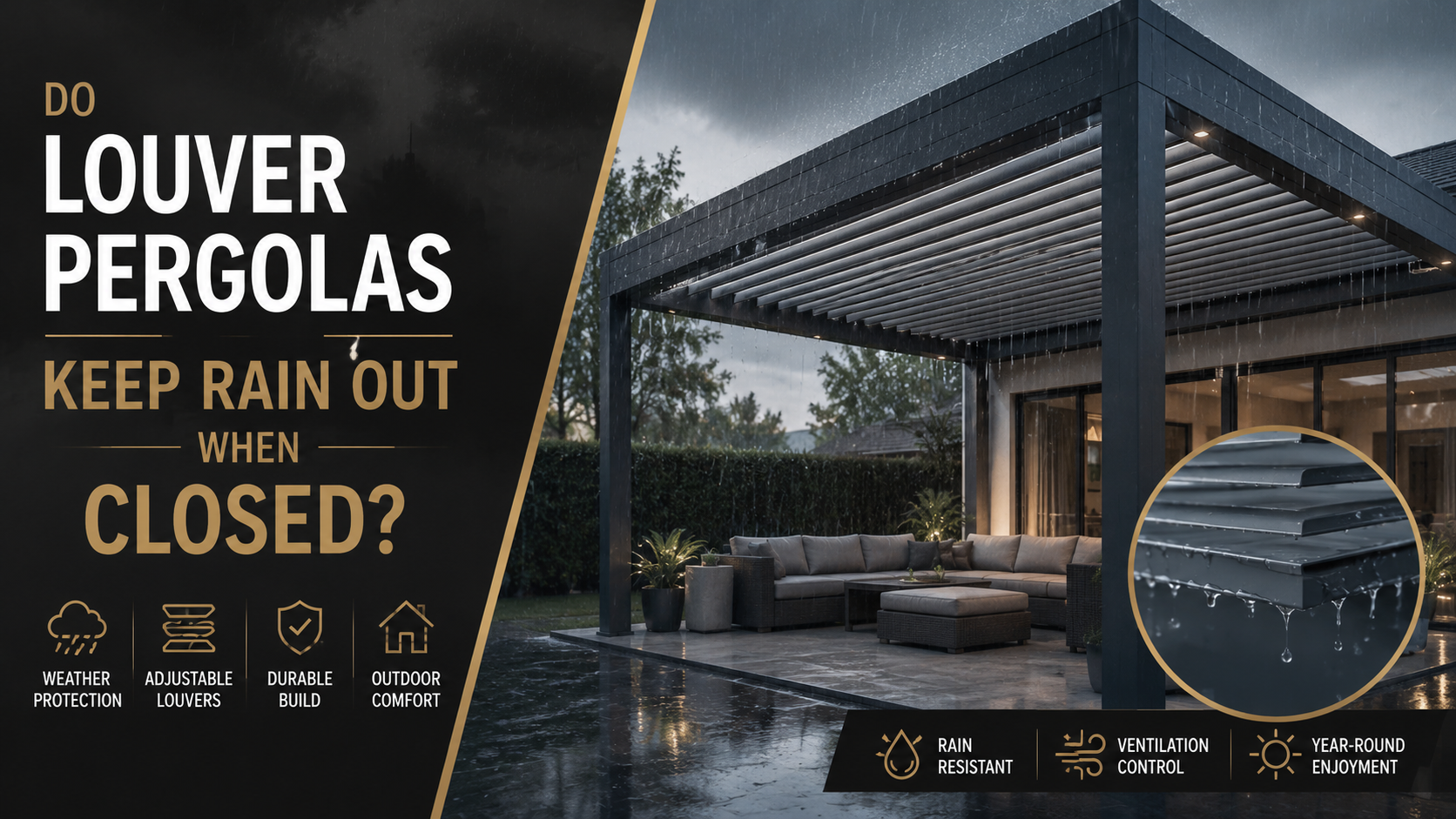
Closed louver roofs keep ordinary rain out, and they are not sealed rooms. The blades interlock along their long edges and form a continuous plane with a slight pitch. Water runs across that plane into a channel at the perimeter, then leaves through the posts. Manufacturers rate this behavior as weather resistance, not as the waterproof envelope a building roof provides.
The gap between those two ideas explains most owner complaints. A closed roof stops vertical rainfall. It does not stop wind-driven rain at the open sides, because a pergola has no walls. Side screens, glass panels, and drop shades close that opening, and each is a separate product from the roof.
How do blade overlap and gaskets stop water?
Blade overlap is the first water barrier in a closed louver roof. Each blade carries a lip that seats against the next blade, so the joint sits above the water line rather than in it. The closed plane also holds a slight pitch, commonly 2 to 5 degrees, which keeps water moving toward the drainage side. Flat blades with no pitch invite ponding, the standing water that finds every weak joint.
A gasket is the flexible strip that fills the remaining gap between blades. The gasket blocks capillary action, the effect that pulls water uphill through a narrow gap. Gaskets also age first: ultraviolet light hardens them, and a hardened gasket stops compressing evenly.
Aluminum moves with temperature, and that movement lands on the joint. Thermal expansion is the reason blade length limits exist. Manufacturers publish a maximum span, and a run built past that limit deflects in the middle and opens the joint.
Where does the water go once it leaves the blades?
Water leaves the blades through a gutter system built into the pergola frame. The perimeter beams are hollow extrusions that double as gutters, and the posts hold the downspout, the vertical pipe that carries water to grade. Drainage built into the structure is what separates a bioclimatic pergola from a fixed patio cover with an external gutter. The path is short, and it repeats at every corner.
- Rain lands on the closed blades and runs along each blade to its low edge.
- The low edge discharges into the perimeter beam, which works as a hidden gutter.
- The beam slopes toward the corner posts.
- Each post carries an internal downspout to grade, a drain line, or a splash block, the pad that spreads flow at the base.
Corner posts do the heavy lifting here, so post count sets drainage capacity. Standard residential downspouts measure 2 by 3 inches or 3 by 4 inches, and internal post channels sit in the same range. Debris is the real limit: a leaf pack at the beam outlet backs water up faster than heavy rain does.
| Component | Job in a closed roof | Symptom when it fails |
| Blade overlap | Forms the primary shedding plane | Steady drip along one blade line |
| Blade gasket | Blocks seepage at the blade joint | Fine spray or mist under the roof |
| Perimeter beam gutter | Collects and routes blade runoff | Water sheets over the outside edge |
| Post downspout | Carries water from beam to grade | Overflow at the top of the post |
| Drip edge | Throws water clear of the frame face | Staining and streaks down the posts |
| Weep holes | Release water trapped inside cavities | Standing water inside the beam |
What does a rain sensor do when the weather turns?
A rain sensor is a contact plate or optical unit mounted on the frame that detects the first drops. The controller then rotates the blades to the closed position with no input from the owner. An empty patio is where this matters, since an open roof over outdoor furniture causes most water damage.
Wind sensors work alongside the rain sensor on many controllers. An anemometer, the instrument that measures wind speed, triggers a preset action once wind passes a set threshold. Rain and wind logic can conflict, because a fabric roof retracts in high wind while a louvered roof stays closed.
Sensors depend on power, and power fails during the storms that matter most. Systems worth specifying include a manual override, either a hand crank or a battery backup that closes the roof once. A sensor also needs cleaning, because pollen film and salt residue cause false triggers. A roof that closes on a clear day usually has a dirty sensor rather than a broken controller.
How much snow can a closed louver roof carry?
Snow load is the design figure that decides whether a closed louver roof survives winter. ASCE 7, the American Society of Civil Engineers standard referenced by the International Building Code, maps ground snow load by location. Most of New Jersey sits in the 20 to 30 pounds per square foot band, and northwestern counties run higher.
Snow weight adds up faster than most owners expect. Packed snow runs roughly 1 to 1.5 pounds per square foot for every inch of depth. 12 inches of packed snow therefore approaches 18 pounds per square foot, and an inch of ice adds about 5 pounds. That weight is live load, the temporary weight a structure carries, and it sits on top of the frame’s own dead load.
Blade position changes the winter equation. A closed roof holds snow on its surface, while an open roof lets snow fall through to the deck. Manufacturers publish a rated snow load for the closed position, and that rating assumes the specified post spacing and footings. Owners in northern New Jersey often open the blades before a heavy storm and clear the deck afterward.
Common misconceptions about closed louver roofs
Misconceptions about closed louver roofs come from comparing them to a solid patio cover. The two structures behave differently at the edges and inside the joints. Each point below marks a place where a bioclimatic pergola performs differently than owners expect.
- A closed roof is not a sealed roof, and a gust still carries water under the open sides.
- Noise is not a fault, because rain on aluminum blades is audible and blade wall thickness changes the volume rather than removing it.
- Dripping after the rain stops is drainage, since water held in each blade channel needs minutes to clear.
- A rain sensor is not a warranty, and it does nothing about a blocked beam outlet or a hardened gasket.
What maintenance keeps a louvered roof watertight?
Maintenance on a louvered roof concentrates on three parts: the gaskets, the beam outlets, and the sensor. A seasonal check takes under an hour and prevents the failures that get blamed on the roof design. Owners in New Jersey and New York usually schedule it twice a year, once after leaf fall and once in spring.
- Rinse the closed blades with a hose and watch where the water exits the frame.
- Clear leaves and seed pods from the beam channel at each corner.
- Press each gasket with a finger, since a gasket that stays compressed has hardened.
- Wipe the rain sensor plate and test the automatic close command.
- Check the footings and post bases for movement, because a settled post reverses the drainage slope.
Louvered roofs in the rain: the practical verdict
Closed louver roofs shed ordinary rainfall and drain it out of sight, which is the direct answer to the question. Four findings define what that means on a real patio. The shedding plane depends on overlap, gasket condition, and a slight pitch, so a hardened gasket is the most common leak source. Drainage capacity lives in the beams and posts rather than in the blades, so post count and outlet cleanliness set the limit.
Wind-driven rain enters from the open sides, and only screens or glass panels close that gap. Snow is a structural question rather than a water question, answered by the rated load, the post spacing, and the local code map. A louvered roof specified against those four points works as a dry outdoor room in most weather.
Blade ratings, snow load allowances, and permit requirements vary by system and by town. Verify the published specification for the exact model, and confirm local requirements with the construction office before ordering.
Frequently Asked Questions
Are louver pergolas completely waterproof when closed?
Louver pergolas are weather resistant rather than waterproof. A closed blade roof sheds vertical rain into an internal gutter and keeps the space below dry in normal conditions. The sides stay open, so wind-driven rain still reaches the floor. Screens, glass panels, or drop shades close that gap.
How does a closed louver roof drain rainwater?
A closed louver roof drains through the frame itself. Rain runs along each blade to its low edge, drops into the hollow perimeter beam, and travels to the corner posts. Each post contains a downspout that carries water to grade. No external gutter or pipe hangs on the structure.
Why does a louvered roof drip after the rain stops?
Dripping after rain is normal drainage rather than a leak. Each blade holds a small volume of water in its channel, and that water needs several minutes to reach the beam. Persistent dripping in dry weather points to another cause: a blocked beam outlet, a hardened gasket, or a settled post.
Can a louver pergola stay closed through winter snow?
Closed louver roofs carry a published snow load, measured in pounds per square foot. That rating assumes the post spacing and footings the manufacturer specifies. Packed snow adds roughly 1 to 1.5 pounds per square foot per inch of depth. Many owners open the blades before a heavy storm so snow falls through.
Does a louver pergola need a building permit in New Jersey?
Permits for a louver pergola sit with the local construction office, which enforces the New Jersey Uniform Construction Code. A roofed structure on footings normally triggers a construction permit and a zoning review for setbacks, the required distance from property lines. Vision Art Aluminium includes drawings and permits as a project step.
Ready for a louvered roof that seals tight when storms roll in? Explore the SkyBlade aluminum louver pergola and get free pricing for your backyard.