

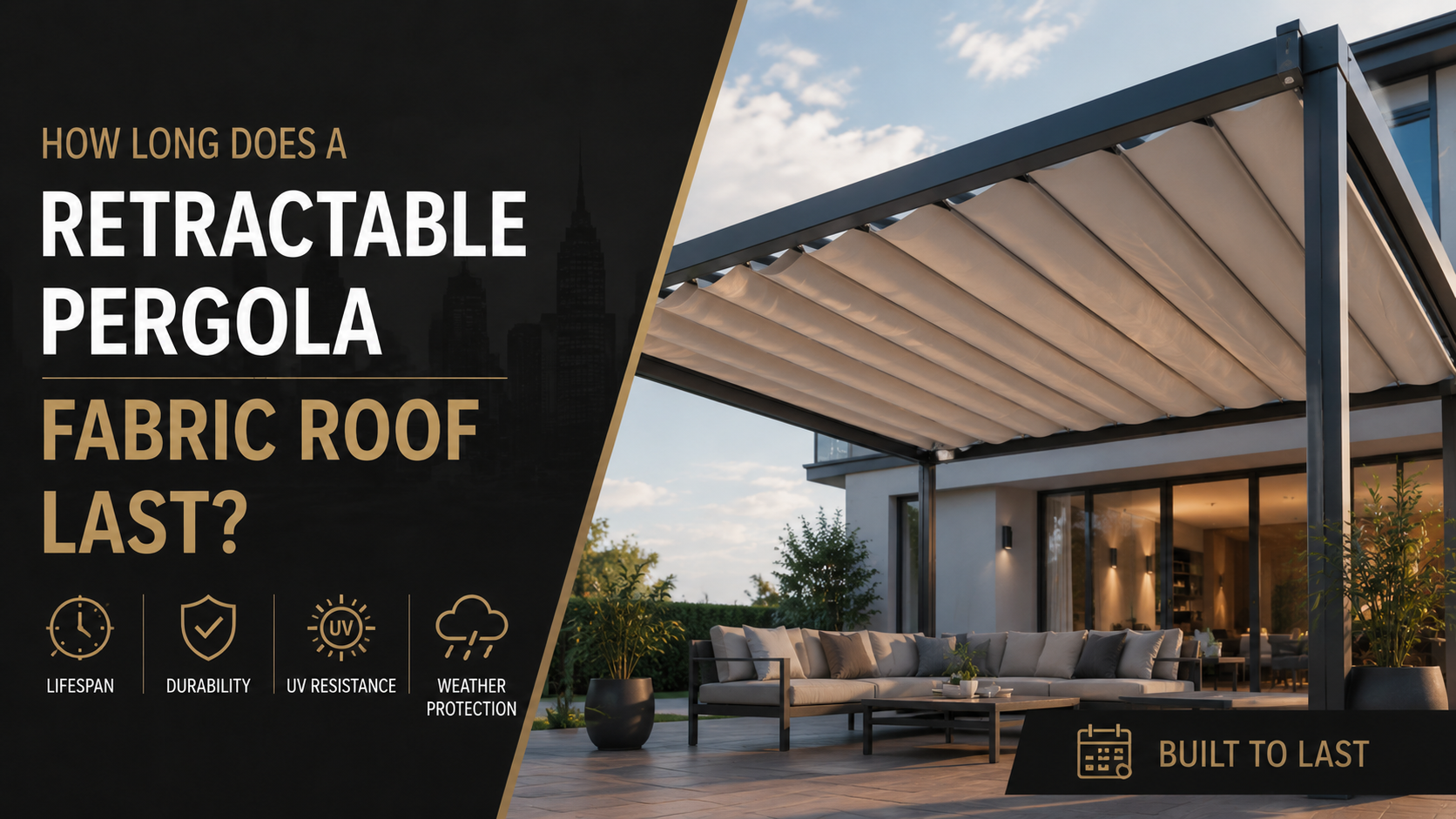
How Long Does a Retractable Pergola Fabric Roof Last
What is a retractable pergola fabric roof?
A retractable pergola fabric roof is a tensioned membrane that opens and closes along an aluminum frame. The membrane is usually PVC-coated polyester: a woven polyester base cloth sealed on both faces with polyvinyl chloride. Base cloth weight on residential systems runs between 12 and 20 ounces per square yard. Coated fabric strength is measured under ASTM D751, an ASTM International method covering breaking strength, tear resistance, and coating adhesion. Patio membranes are also tested for flame propagation under NFPA 701, a National Fire Protection Association standard for textiles. The aluminum frame carries structural load. The fabric sheds water and blocks sun, so it ages on a different clock than the frame under it.
How many years does the membrane last?
Membrane life on a motorized system runs 8 to 15 years in the New Jersey and New York climate. Heavier PVC-coated polyester with a PVDF (polyvinylidene fluoride) topcoat sits at the top of that band. Lighter awning cloth in solution-dyed acrylic, where pigment goes into the fiber instead of onto it, carries manufacturer warranties of 5 to 10 years. Warranty length and service life are different numbers. A warranty covers color loss and delamination, meaning separation of the coating from the base cloth, inside a fixed window.
Service life ends earlier than most owners expect, because it ends at function rather than appearance. A membrane is finished when it no longer tensions flat, seals at the rails, or drains without pooling.
How does sunlight break down the membrane?
Sunlight degrades a fabric roof through ultraviolet (UV) radiation, heat cycling, and trapped moisture. UV energy reaches the lacquer topcoat first and thins the layer that gives the surface its gloss and dirt resistance. Fabric makers screen this with accelerated weathering under ASTM G155, a xenon-arc exposure test that often runs 1,000 hours or longer. The slower mechanism is plasticizer migration: the additives that keep PVC flexible leave the coating year by year. Fabric that has lost plasticizer holds every fold, and cracks begin along the crease lines where the roof rolls.
Surface chalking, a powdery residue that rubs off on a finger, marks the point where the topcoat has gone. South and west elevations reach that point several seasons before shaded north faces do.
Why do seams and edges wear out first?
Seams and edges reach failure before the open field of the fabric does. Welded seams, formed by high-frequency welding that fuses the coating of two panels, last as long as the coating lasts. Stitched seams age differently: UV-stabilized polyester thread breaks down faster than the solution-dyed acrylic cloth around it. PTFE (polytetrafluoroethylene) thread removes that mismatch, which is why many awning fabricators specify it on exposed work. The keder edge, the rope-like bead sewn into the fabric hem that rides inside the rail, wears wherever grit collects.
Wear appears in a repeatable order on retracting systems:
- Dull, chalky patches on the south and west faces where the topcoat has thinned
- Stitching that opens at panel joints while the fabric itself still feels sound
- Permanent creases that no longer flatten once the roof is fully extended
- Fraying at the keder bead, usually at the end nearest the motor
- Water pooling instead of running off, which signals lost tension
Fabric grades and expected service life
Fabric grade sets the outer limit on how long a roof survives. Coating chemistry and topcoat quality decide the result more than raw weight does. Waterproofing is rated as hydrostatic head, the height of a water column the fabric resists before it leaks.
| Fabric type | Typical weight | Main strength | Expected service life |
| Solution-dyed acrylic awning cloth | 9 to 11 oz per square yard | Color retention and breathability | 7 to 12 years |
| PVC-coated polyester, Type I | 12 to 15 oz per square yard | Water shedding at lower cost | 8 to 12 years |
| PVC-coated polyester, Type II with PVDF topcoat | 16 to 19 oz per square yard | Dirt resistance and UV stability | 12 to 15 years |
| Three-layer awning composite | 13 to 18 oz per square yard | Waterproofing and shape stability | 10 to 15 years |
Multi-layer composites bond a barrier film between two face layers. Motorized systems built for the New Jersey and New York climate, including the SkyFlow retractable pergola from Vision Art Aluminium, use a three-layer awning membrane. The barrier film blocks water and slows UV transmission to the inner face. Extra layers raise fabric weight, so roller diameter and motor torque have to match the specification.
Does winter shorten the life of the fabric?
Winter shortens fabric life through snow load and trapped moisture rather than cold air alone. A retractable membrane sheds weather and carries no snow load rating. Leaving it extended through a storm stretches the fabric and strains the roller tube. EN 13561, the European standard for external blinds and awnings, rates wind resistance in classes 0 through 3. Class 3 corresponds to Beaufort force 6, roughly 30 miles per hour.
Retracting the roof before the first freeze protects tension across the full width. Rolling it away wet causes the more common damage: months of trapped damp produce mildew staining on acrylic and coating haze on PVC.
How do the motor and tracks affect fabric life?
Motor and track condition decide whether the membrane tensions evenly across its width. A tubular motor turns the roller tube. Most residential units carry a duty cycle near 4 minutes, the continuous run time before the thermal cutout stops the unit. A worn glide drags one side of the fabric behind the other. That skew loads the membrane diagonally and pulls the keder bead out of the rail over time.
Annual service on a retractable pergola takes under an hour and protects the fabric:
- Clear the rails of leaf grit, then lubricate with dry silicone rather than petroleum grease
- Check the limit switches so the roof stops at full tension instead of over-rolling
- Test the rain and wind sensors at the start of every season
- Wash the membrane with mild soap and cool water, never a pressure washer
Common misconceptions about fabric roof lifespan
Misconceptions about fabric roofs come from comparing them to shingles or metal panels. Four assumptions cause most of the disappointment:
- Heavier fabric always lasts longer. Coating and topcoat quality outrank weight on the sun-facing side.
- A ten-year warranty means ten years of use. Warranties cover defects, not gradual stiffening.
- Fabric failure ends the system. One aluminum frame routinely outlives three membranes.
- More cleaning helps. Pressure washing strips the lacquer topcoat and shortens fabric life directly.
What does a membrane replacement involve?
Membrane replacement is a component job on the same frame. The aluminum structure, posts, roller tube, motor, and rails stay in place while only the fabric changes. A crew withdraws the old membrane from the keder rails, measures the frame as built, and orders a panel cut to that pattern. As-built measurement matters because posts settle and frames move slightly after years of thermal cycling. Fitting a single-bay roof is normally a one-day job once the fabric arrives.
Replacement cost follows membrane area, mounting height, and seam type rather than the age of the system. Welded seams cost more to fabricate than stitched seams and hold longer in full sun. Roof-deck and elevated installations add lift access to the labor line. Replacement is also the practical moment to change grade, since the rails accept any fabric made to the correct keder size.
What a realistic replacement timeline looks like
A realistic timeline plans for one membrane change inside the first fifteen years of ownership. Four findings shape that plan. Fabric grade sets the range, and a PVDF-topcoated membrane buys roughly 3 to 5 extra years over entry-grade acrylic cloth. Seams and the keder edge fail before the open fabric, so inspection belongs there. Winter retraction and dry storage protect more life than any cleaning routine does. Replacement touches the fabric alone, which keeps the frame, motor, and rails in service across several membranes.
Fabric specifications, warranty terms, and replacement pricing change by manufacturer and by system. Confirm the current fabric grade, seam type, and warranty coverage with the supplier before ordering a replacement membrane.
Frequently Asked Questions
How often does a retractable pergola fabric roof need replacing?
A retractable pergola fabric roof normally needs replacing once every 8 to 15 years. Exposure sets the position inside that range, since south and west elevations age faster than shaded north faces. Systems that are retracted through winter and stored dry reach the upper half. The frame, motor, and rails are not replaced at the same time.
Can a fabric pergola roof stay open through winter?
A fabric pergola roof is not built to stay open through a snow-country winter. The membrane sheds rain but carries no snow load rating, so accumulation stretches the fabric and strains the roller tube. Retracting before the first storm is standard practice across New Jersey and New York. Wet fabric is dried before it is rolled away.
Does rain damage a retractable pergola fabric roof?
Rain does not damage a properly tensioned membrane, because PVC-coated polyester is waterproof by construction. Damage starts when tension drops and water pools in a low spot. Standing water stretches the fabric, holds dirt, and freezes during winter nights. A slope of at least 1 inch per foot keeps the surface draining after every storm.
How do you clean a pergola fabric roof safely?
Safe cleaning uses mild soap, cool water, and a soft brush on a fully extended membrane. Rinsing matters because soap residue attracts dirt and holds moisture against the coating. Pressure washers and solvent cleaners strip the lacquer topcoat and shorten fabric life. Drying the membrane completely before retraction prevents mildew staining inside the cassette.
Which fails first, the fabric or the aluminum frame?
The fabric fails first in nearly every retractable system. A powder-coated aluminum frame resists corrosion for decades, while the membrane above it takes direct UV, rain, and folding stress. Motors and rails sit between the two in expected life. Budgeting for fabric separately from the structure reflects how these systems actually age.