

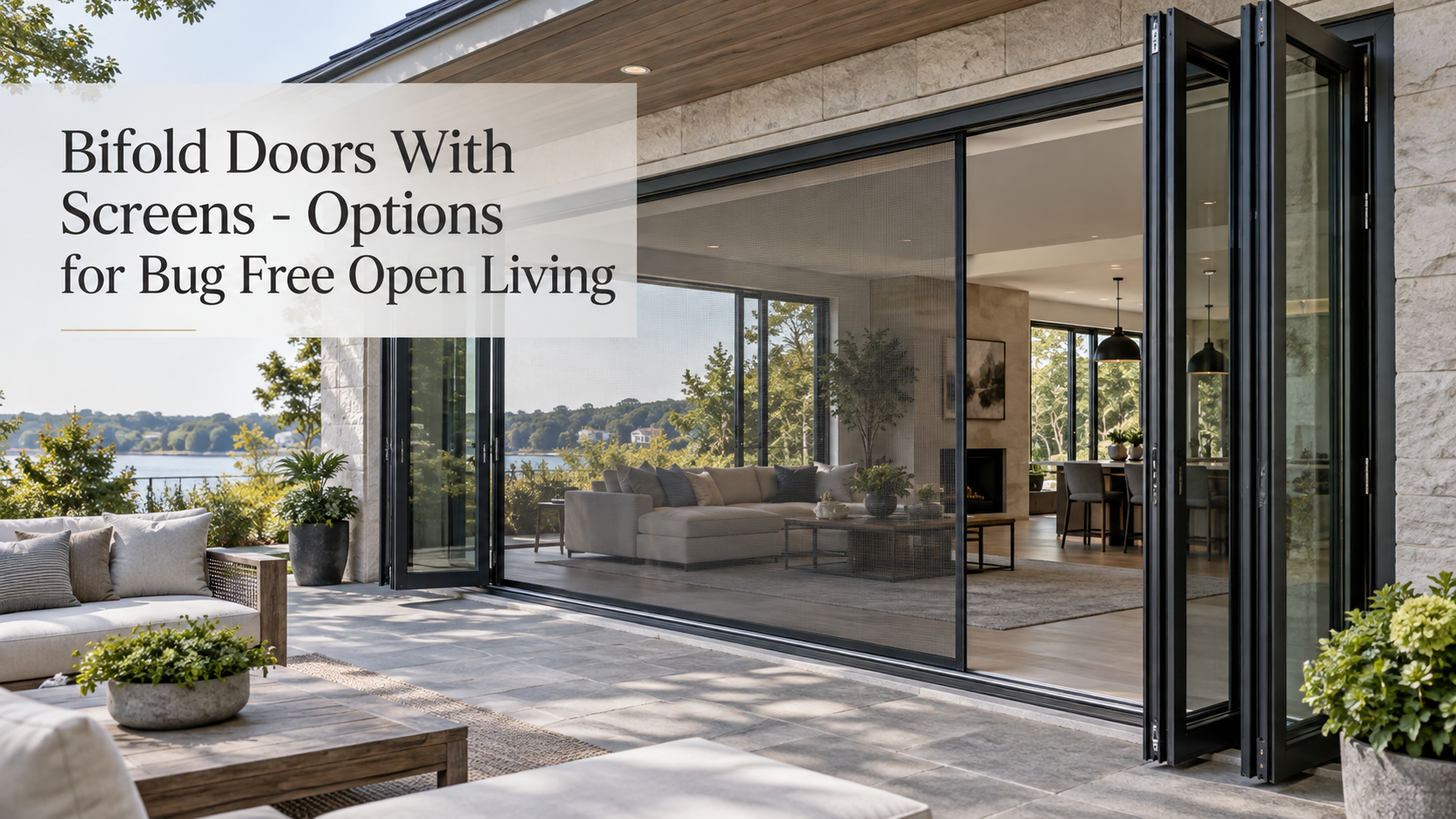
Bifold Doors With Screens – Options for Bug Free Open Living
Bifold doors can open a large portion of an exterior wall, but that openness creates an obvious warm-weather question: how do you bring in fresh air without inviting mosquitoes and other insects inside? The practical answer is to plan the screen as part of the opening rather than treating it as an accessory added after the folding door is installed.
Vision Art Aluminium designs custom aluminum bi-fold door systems for residential and commercial openings throughout New Jersey and New York. Its folding systems are built around wide openings, slim thermally broken aluminum profiles, insulated glazing and configurable panel arrangements. Vision Art project examples also document retractable insect screens installed alongside folding doors and folding windows, showing how the two systems can work together when ventilation and insect control are both priorities.
How Do Bifold Doors Work With Insect Screens?
A bi-fold door uses multiple glazed panels that fold and stack toward one side or both sides of an opening. When the panels are open, most of the doorway can become a direct connection between the interior and the patio, terrace or other outdoor area.
An insect screen adds a second movable layer across that opening. Vision Art Aluminium has used retractable insect screens in completed folding-door projects where homeowners wanted fresh air without leaving the interior fully exposed to mosquitoes and other insects. When protection is needed, the screen extends across the opening. When it is not needed, it retracts away so the broad opening and exterior view can remain visually clear.
This combination preserves the main reason homeowners choose bifold patio doors in the first place: the ability to change a glazed exterior wall into a much more open connection with the outdoors.
Which Screen Options Make Sense With a Folding Door?
The word “screen” can describe several different products, so the intended use matters. A screen designed primarily for a large folding doorway has different requirements from a vertical shade used around a pergola.
Screen option | How it relates to the opening | Primary role | What should be confirmed |
Retractable insect screen | Extends across the open folding-door area and retracts when not required | Fresh-air ventilation with insect control | Opening dimensions, screen integration, threshold conditions and panel stack location |
Pleated screen | A project-specific screen format that may be considered for an operable opening | Insect screening while maintaining an open-door mode | Compatibility with the specific bi-fold configuration before fabrication |
Zip screen | Runs vertically within retained side channels on a framed outdoor opening | Insect control plus varying degrees of shade and privacy depending on fabric | Frame configuration, fabric selection and intended outdoor use |
Why Are Retractable Screens a Natural Match for Bifold Doors?
A fixed screen would undermine much of the flexibility of a wide folding opening. A retractable system follows the same general design objective as the door: it is available when needed and moves away when the homeowner wants a more open connection.
Vision Art Aluminium has documented this arrangement in completed projects in New York. In one waterfront residence, retractable insect screens were coordinated with both a custom aluminum bi-fold door and a folding kitchen window. The screens could be extended when ventilation was wanted and retracted when the owners wanted the primary viewing areas clear. Another completed project used a retractable insect screen with a large aluminum bi-fold opening for a photography studio.
These examples also highlight why screen planning should happen early. The door panels, screen, threshold, surrounding wall construction and finished floor relationships form one coordinated opening. Screen integration is therefore more predictable when it is considered alongside the folding-door configuration rather than after the surrounding construction is finished.
What About a Pleated Screen?
A pleated screen may come up when homeowners compare compact insect-screen formats for a bi fold door opening. It should not automatically be treated as interchangeable with the retractable systems shown in Vision Art Aluminium’s published folding-door projects.
The Vision Art project information used here specifically documents retractable insect screens with aluminum folding systems. It does not establish a particular pleated-screen specification as a standard configuration. If a pleated format is preferred, compatibility should therefore be confirmed for the actual project, including the opening dimensions, folding direction, stack position and threshold arrangement.
That distinction matters because an aluminum bifold door is custom configured around the measured opening. Vision Art Aluminium allows project-specific decisions such as inward or outward folding, left or right stacking and different panel arrangements. The screening solution needs to coexist with those moving components rather than obstruct them.
When Is a Pergola Zip Screen the Better Solution?
A zip screen serves a different type of opening. Instead of screening a folding door directly, it is designed as a vertical screen for framed outdoor structures such as pergolas and patio enclosures.
Vision Art describes zip screens as fabric systems whose edges remain captured in side channels as the screen travels between its upper housing and lower position. With suitable mesh, the system can help control insects while still allowing air and light through. Fabric selection can also change the balance between outward visibility, shade and privacy.
This makes zip screens particularly relevant when the open-living area extends beyond the house. For example, a home can use aluminum bifold doors between the kitchen or living room and patio, then use vertical zip screens around a pergola farther outside. The door manages the building opening while the pergola screens manage the perimeter of the covered outdoor zone.
Can Bifold Doors and Pergola Screens Be Used Together?
Yes. They solve different layers of the same indoor-outdoor plan. The folding door determines how much of the house can open toward the patio. The retractable insect screen can protect that doorway when the glass panels are folded aside. A pergola with zip screens can then create another screened boundary around the outdoor seating or dining area.
Vision Art Aluminium’s louvered pergola information includes zip screens among the available enclosing concepts, alongside folding doors and other glazed systems. This allows screening decisions to be considered as part of the larger architecture rather than as unrelated products.
The important limitation is that a screen is not the same thing as insulated glazing. Vision Art’s zip-screen information distinguishes vertical screening from a fully sealed glass enclosure. Screens can provide insect control and varying levels of shade, privacy and side protection, but they do not turn an open structure into the equivalent of an insulated room.
What Should Be Planned Before Ordering Bifold Doors With Screens?
The first decision is how the doorway should work when fully open. Folding direction and stacking position affect where the door panels sit, while the threshold affects the transition between interior and exterior surfaces. The screen then has to operate without interfering with that movement.
- Decide where the folding panels should stack when the opening is fully open.
- Determine whether the screen is primarily for insects or also needs shade and privacy functions.
- Plan the screen together with the threshold and surrounding construction.
- Confirm whether a retractable insect screen or another screen format is compatible with the measured opening.
- For a pergola beyond the doorway, consider whether side-guided zip screens should form a second screened zone.
For homeowners in New Jersey and New York, this coordinated approach can create several useful modes within the same space: closed glazing when separation from outdoor conditions is needed, an open folding wall for direct indoor-outdoor circulation, and screened ventilation when fresh air is welcome but insects are not. Vision Art Aluminium is based in Montclair, New Jersey and develops its aluminum door and outdoor-living systems around the dimensions and intended use of each project.