

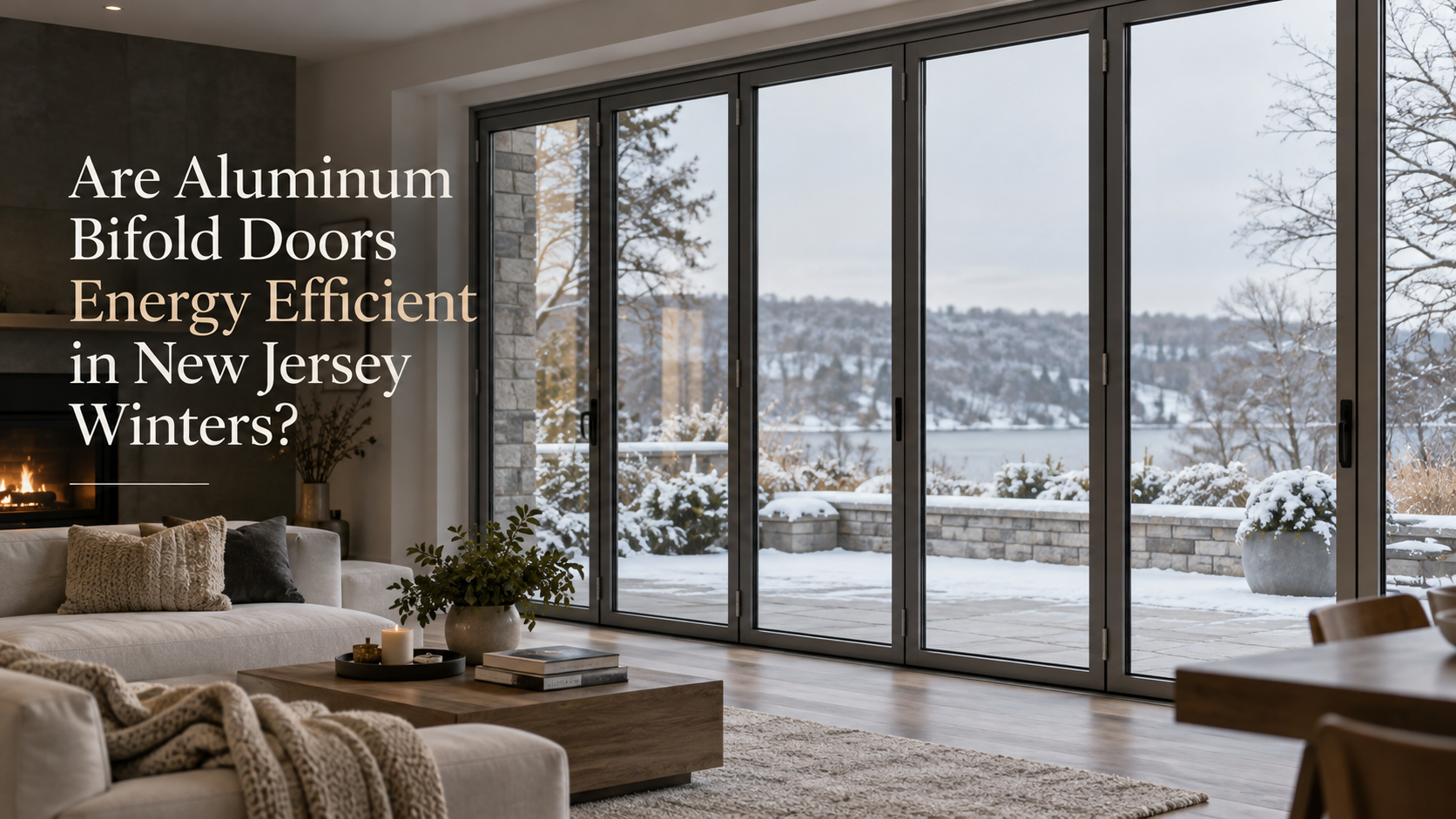
Are Aluminum Bifold Doors Energy Efficient in New Jersey Winters?
Yes, a properly configured bifold door can support winter comfort in a New Jersey home, but the result depends on the complete door assembly rather than aluminum alone. Vision Art Aluminium combines thermally broken aluminum profiles, insulated glazing and weather-tight sealing in its exterior folding systems. Those three elements matter because they address the main paths for winter heat loss: the frame, the glass and the joints between moving panels.
For homeowners comparing large glazed openings, the practical question is not simply whether a folding system is efficient. It is whether the specific frame, glass package, gaskets, threshold and installation details are appropriate for an exterior opening that will remain closed through cold weather. Vision Art Aluminium designs custom systems for New Jersey and New York, with project-specific configurations based on the measured opening and intended use.
Why does the thermal break matter in an aluminum frame?
Aluminum is structurally well suited to slim profiles and large glazed panels, but it also transfers heat readily if the interior and exterior portions of the frame are directly connected. A thermal break introduces an insulating barrier within the profile, separating those two sides and reducing direct thermal transfer through the frame.
This is why the frame construction deserves attention when evaluating aluminum bifold doors for an exterior wall. Vision Art Aluminium describes its folding systems as using thermally broken aluminum profiles, and its completed New Jersey projects pair that frame strategy with insulated glazing. The thermal break does not eliminate heat transfer through the frame, but it addresses a major weakness of conventional non-thermal aluminum framing.
How much does the glass package affect winter performance?
In a wide folding wall, glass occupies most of the visible area, so the glazing package has a direct role in how the opening performs when closed. Vision Art Aluminium identifies insulated glazing and double-pane strategies as part of its bi-fold systems, while completed projects in New Jersey use double-pane tempered Low-E insulated glass.
Low-E glass is used to help manage heat transfer through the glazing while preserving daylight and exterior views. In practical terms, that means the winter performance of bifold patio doors should be judged from the frame and glass together. A thermally broken frame paired with an appropriate insulated glass package is a more complete approach than evaluating either component on its own.
What do gaskets and weather seals do?
A folding wall has more panel joints and moving interfaces than a fixed glazed wall. That makes sealing especially important. Vision Art Aluminium states that its bi-fold system uses multi-point weather seals and weather-tight gaskets intended to reduce drafts, air infiltration and water penetration when the panels are closed.
The locking and sealing functions also work together. As the system closes, consistent compression at the seals helps create a tighter perimeter and reduces the cold-air leakage that homeowners often notice as a draft. For winter use, this detail can be just as important to perceived comfort as the glass itself. A good glass package cannot compensate for poorly aligned panels or seals that do not close consistently.
How should homeowners use U-value when comparing a bi fold door?
U-value is one of the technical measures used to describe heat transfer through a building component. For comparison purposes, homeowners should focus on the value for the actual proposed configuration rather than assuming that every folding-door layout has the same result.
Vision Art Aluminium’s public bi-fold product page does not publish one universal U-value for every possible door. Its technical resources instead identify U-values, glazing performance data and project-specific glass selections as information that can be coordinated for a project. That distinction matters because panel arrangement, glass selection and other system details can vary from one opening to another.
If winter energy performance is a priority, ask for the thermal data that applies to the proposed assembly. The company’s technical performance resources are the appropriate place to review available glazing and system information rather than relying on a generic number that may not match the final configuration.
Which parts of the system should be compared?
Component | What Vision Art Aluminium identifies | Why it matters in winter |
Frame | Thermally broken aluminum profiles | Reduces direct heat transfer through the aluminum frame. |
Glass | Insulated glazing with double-pane and Low-E configurations used on completed projects | Supports better thermal performance across the large glazed area. |
Gaskets and seals | Weather-tight and multi-point sealing strategy | Helps limit drafts and air infiltration at panel joints and perimeter connections. |
Locking and alignment | Multi-point locking and precision hardware | Supports consistent closure so seals can compress as intended. |
Project-specific thermal data | U-values and glass performance information available through technical resources | Allows the selected configuration to be evaluated instead of relying on a generic claim. |
Can a large folding opening still feel comfortable in winter?
It can, provided the entire assembly is designed for exterior use and closes correctly. Vision Art Aluminium’s completed projects in places such as Freehold and Cherry Hill use thermally broken aluminum framing with insulated Low-E glass. Those projects show how the company approaches large residential openings that need both wide-open warm-weather use and closed winter performance.
Size alone does not determine whether the room will feel cold. The relevant issues are thermal transfer through the frame and glass, air leakage around the perimeter and folds, and the quality of installation and adjustment. This is also why a large glazed wall should be treated as one coordinated system rather than as a collection of separate panels.
What should a New Jersey homeowner verify before choosing a system?
- Thermally broken framing: Confirm that the exterior system uses a thermal break rather than a basic non-thermal aluminum profile.
- Insulated glass configuration: Ask which glass package is proposed for the specific opening and whether Low-E insulated glazing is part of the design.
- Weather sealing: Review how the system seals at the perimeter, panel joints and threshold when fully closed.
- Configuration-specific U-value: Request the applicable thermal data instead of assuming one published figure covers every layout.
- Installation and final adjustment: Large folding panels need accurate measurement, alignment and hardware adjustment so the locking and sealing system works as intended.
When might another door format make more sense?
A folding system is most compelling when opening a large portion of the wall is a priority. If the homeowner mainly wants the simplest everyday passage with fewer moving panel joints, a sliding or conventional hinged format may fit the use case better. Vision Art Aluminium’s door range includes multiple opening styles, so the decision can be based on how much clear opening, glass area and daily access the space actually needs.
For New Jersey homes, energy performance should therefore be evaluated alongside the reason for choosing a folding wall in the first place. The benefit of a bifold system is the ability to stack panels aside and create a broad indoor-outdoor opening. Winter suitability comes from specifying that opening with the right thermal break, glazing, seals and installation details.
Are bifold doors energy efficient enough for New Jersey winters?
They can be when the system is specified as a complete exterior assembly. Vision Art Aluminium’s current bi-fold offering combines thermally broken aluminum framing, insulated glazing and weather-tight sealing, all of which are relevant to reducing winter heat loss and drafts. The company does not present one universal U-value for every configuration, so the more reliable approach is to review the proposed glass and system data for the actual project.
Vision Art Aluminium is based in Montclair and serves projects across New Jersey and New York. For a New Jersey exterior opening, the most useful comparison is not aluminum versus another material in isolation. It is the performance of the complete closed system: frame, glass, gaskets, threshold, locking alignment and installation working together.