

Fire-Rated Aluminum Composite Panels: PE, FR and A2 Grades Explained
What is a fire-rated aluminum composite panel?
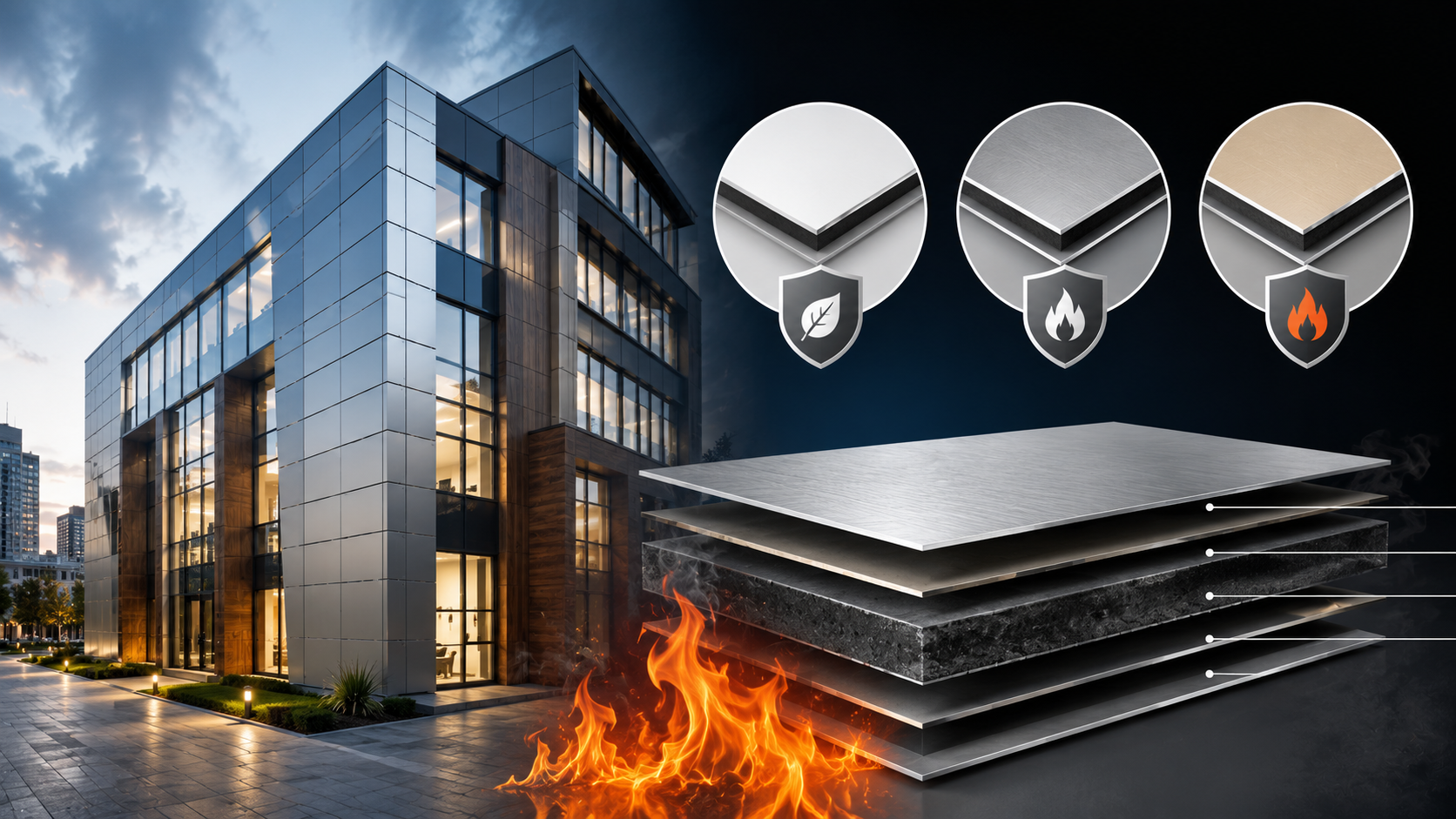
A fire-rated aluminum composite panel is a cladding board whose core resists ignition and slows flame spread to meet a defined fire class. The panel is a sandwich: two thin aluminum sheets bonded to a central core, usually 3mm to 4mm thick in total. The core material decides the fire rating, and ranges from standard polyethylene to fully mineral-filled cores tested under European and North American standards.
Aluminum composite panel (ACP) systems use this layered build for cladding, signage, and building facades. Vision Art Aluminium, a New Jersey based aluminum contractor in Montclair serving New Jersey and New York, supplies ACP including an Aluboard variant for facade and signage work. The fire grade printed on a panel datasheet, such as PE, FR, or A2, tells a specifier how the core behaves when exposed to a flame.
Fire grade matters because cladding sits on a building’s exterior, where a fire can travel up a facade fast. The 2009 introduction of stricter combustibility rules across several markets followed real facade fire incidents. A panel marked A2 contains a core that is almost entirely non-combustible mineral filler, while a PE panel core is mostly plastic.
How does an ACP fire core work?
ACP fire performance works through the chemistry of the core trapped between the two aluminum skins. The aluminum itself does not burn in a typical building fire, but it conducts heat and softens near 660 degrees Celsius, its melting point. Once the skin deforms, the core is exposed, and the core’s makeup determines whether the panel adds fuel or starves the flame.
Polyethylene, a thermoplastic also called PE, melts and burns readily, releasing heat that feeds flame spread. Fire-retardant and mineral cores replace much of that plastic with non-combustible mineral fillers, often aluminum hydroxide (also written as aluminum trihydrate). When heated, this filler releases water vapor, which cools the panel and dilutes flammable gases.
The mineral content sets the grade. A standard PE core can be 100 percent polyethylene. An FR core typically mixes roughly 30 percent polymer with 70 percent mineral filler. An A2 core pushes mineral content above 90 percent, leaving only a small polymer binder, which is why A2 panels barely contribute to a fire.
The role of aluminum hydroxide
Aluminum hydroxide is the mineral filler that gives FR and A2 cores their fire resistance. The compound breaks down endothermically, meaning it absorbs heat as it decomposes near 180 degrees Celsius. That reaction releases water and pulls energy away from the flame front, slowing combustion at the panel surface.
What do PE, FR and A2 grades mean?
PE, FR, and A2 are the three core grades that classify an ACP by how much its center resists fire. PE stands for polyethylene, FR stands for fire-retardant, and A2 refers to the Euroclass A2 fire rating under standard EN 13501-1, the European classification for reaction to fire. Each grade marks a step up in mineral content and a step down in combustibility.
PE-core panels carry the lowest fire resistance and often classify as Euroclass B or worse. FR-core panels reach Euroclass B-s1,d0 in many product lines, meaning limited combustibility with low smoke and no flaming droplets. A2-core panels reach A2-s1,d0, the highest practical class for a composite panel, treated as non-combustible for most code purposes.
The Euroclass codes after the letter describe smoke and droplets. The s rating runs s1 to s3 for smoke production, where s1 is the lowest smoke. The d rating runs d0 to d2 for flaming droplets, where d0 means no burning droplets fall. A full class such as A2-s1,d0 packs all three signals into one label.
PE vs FR vs A2: the grade comparison table
The grade comparison below sets PE, FR, and A2 cores side by side on the specifications that drive code compliance and material selection. The figures reflect typical industry ranges for the three core families; exact values vary by manufacturer and product line, so a project datasheet is the binding source.
| Property | PE (polyethylene) | FR (fire-retardant) | A2 (non-combustible) |
| Core makeup | Up to 100% polyethylene | ~30% polymer, ~70% mineral | 90%+ mineral filler |
| Typical Euroclass | B to E | B-s1,d0 | A2-s1,d0 |
| Combustibility | Combustible | Limited combustibility | Treated as non-combustible |
| Smoke (s rating) | s1 to s3 | s1 | s1 |
| Flaming droplets (d rating) | d0 to d2 | d0 | d0 |
| Common use | Interior signage, low-rise | Mid-rise facades | High-rise, code-restricted facades |
| Relative cost | Lowest | Mid | Highest |
The cost gap tracks the mineral content: more filler means a heavier, pricier panel. Panel weight also rises with grade, since mineral filler is denser than polyethylene, which affects fixing systems and structural load calculations on tall buildings.
Why does ACP fire grade matter for facades?
ACP fire grade matters because cladding on a multi-story building creates a vertical path that fire can climb. A combustible core behind a thin aluminum skin can ignite, spread flame between floors, and bypass internal fire compartments. Several jurisdictions now restrict or ban PE-core panels on buildings above a set height after facade fire investigations.
In the United States, building codes reference NFPA 285, a standard from the National Fire Protection Association that tests how an exterior wall assembly resists vertical and lateral flame spread. The International Building Code (IBC) requires this assembly test for many combustible components on buildings over 40 feet tall. A panel’s core grade directly affects whether its full wall assembly can pass.
Fire class also feeds insurance and approval workflows. A specifier who selects an A2 panel for a high-rise removes a combustibility question that a PE panel would raise at plan review. The grade is therefore a compliance decision, not only a material preference, and it is documented on the project’s fire-engineering record.
What are common misconceptions about fire-rated ACP?
Common misconceptions about fire-rated ACP cluster around the words “fireproof” and “FR.” No aluminum composite panel is fireproof: even A2 cores contain a small polymer binder and will react under extreme heat. The grades describe controlled, classified behavior, not total immunity to fire.
- FR does not equal non-combustible. FR cores still classify as limited-combustibility Euroclass B in many lines, while only A2 is treated as non-combustible.
- The aluminum skin is not the fire risk. The thin outer sheets melt early; the core decides the rating.
- A fire test on the panel alone is not the full picture. Codes test the wall assembly (panel plus insulation, cavity, and fixings) under NFPA 285 or EN methods.
- Thicker is not automatically safer. A 4mm PE panel can rate worse than a 3mm A2 panel, because core chemistry, not thickness, drives the class.
- One supplier’s “FR” is not identical to another’s. The class on the datasheet, not the marketing name, is the verifiable figure.
How is fire-rated ACP applied in practice?
Fire-rated ACP is applied as a rainscreen cladding layer fixed to a building’s structural wall through a sub-frame. The panels mount onto aluminum carrier rails with a ventilated cavity behind them, which manages moisture and, on rated assemblies, controls airflow that could feed a fire. The fixing method itself forms part of the tested assembly.
Vision Art Aluminium fabricates and installs aluminum composite panel systems for facade, cladding, and signage projects across New Jersey and New York. Its sourcing draws on European system partners, including Schüco (Germany), Reynaers (Belgium), and Rehau (Germany), whose engineering standards shape the company’s product lines. The Aluboard variant is offered for facade and signage applications.
On a live project, grade selection follows three checks: the building height against local code, the required Euroclass or NFPA 285 assembly result, and the structural load the chosen panel adds. A drawings-and-permits stage documents the fire grade before manufacturing starts, so the installed panel matches the approved fire-engineering record.
The fire-grade verdict for ACP specifiers
Fire-rated ACP comes down to matching core grade to building height and code, not to chasing the highest number on every job. PE cores fit interior signage and low-rise work where combustibility rules are relaxed. FR cores carry limited-combustibility Euroclass B-s1,d0 for many mid-rise facades, while A2 cores reach A2-s1,d0 and clear the bar where codes treat cladding as non-combustible.
The core chemistry, mineral filler content above 90 percent for A2 versus mostly polyethylene for PE, is the single fact that drives the rating. Thickness, brand name, and the word “FR” do not substitute for the classified figure on a project datasheet. For tall or code-restricted buildings, the wall assembly test (NFPA 285 in the United States) governs, so panel grade is verified at the assembly level, not in isolation.
This content is for general informational purposes only and is not a substitute for fire-engineering or code-compliance advice. Verify the required fire class and the panel datasheet with a qualified professional and your local building authority before specifying.
Frequently Asked Questions
What is a fire-rated aluminum composite panel?
A fire-rated aluminum composite panel is a cladding board with a core engineered to resist ignition and meet a defined fire class. It pairs two thin aluminum skins around a central core whose mineral content sets the grade. The three common grades are PE (polyethylene), FR (fire-retardant), and A2 (non-combustible under Euroclass EN 13501-1).
How does an A2-rated ACP differ from FR?
An A2-rated ACP differs from FR mainly in mineral content and combustibility. A2 cores hold more than 90 percent mineral filler and classify as A2-s1,d0, treated as non-combustible for code purposes. FR cores hold roughly 70 percent filler and reach limited-combustibility class B-s1,d0. A2 therefore suits higher and more code-restricted buildings than FR.
Why does ACP fire grade matter for tall buildings?
ACP fire grade matters for tall buildings because cladding creates a vertical surface that fire can climb between floors. Combustible PE cores can spread flame past internal compartments. In the United States, the IBC requires an NFPA 285 wall-assembly test for many combustible components on buildings over 40 feet, so the panel grade directly affects approval.
What are the common misconceptions about fire-rated ACP?
The common misconceptions are that any ACP is fireproof, that FR means non-combustible, and that thickness sets the rating. No ACP is fireproof, since even A2 cores hold a small polymer binder. FR remains a limited-combustibility class, not non-combustible. Core chemistry, not panel thickness, determines the Euroclass figure on the datasheet.
How do you select the right ACP fire grade?
Selecting the right ACP fire grade starts with the building height checked against local code, then the required Euroclass or NFPA 285 assembly result, then the added structural load. The classified figure on the project datasheet is the binding source, not the marketing name. A fire-engineering professional and the local building authority confirm the final specification.