

Aluminum Window U-Values and Thermal Breaks Explained
What is a window U-value?
A window U-value is the rate at which heat passes through a complete window assembly, measured in watts per square meter kelvin (W/m2K) or, in United States ratings, Btu per hour per square foot per degree Fahrenheit. The U-value (also called U-factor) covers the whole unit: the glass, the spacer, and the frame together. Lower numbers mean less heat escapes. A typical modern double-glazed unit lands near 1.4 W/m2K, while older single glazing can sit above 5.0 W/m2K.
The U-value differs from the R-value, the insulation rating common in United States construction for walls and roofs. R-value measures resistance to heat flow, so a higher R-value insulates better. U-value measures the inverse: heat transmission, where a lower figure performs better. The two are mathematically reciprocal (U equals 1 divided by R), which is why builders quote walls in R and windows in U.
Vision Art Aluminium, a Montclair, New Jersey manufacturer and contractor serving New Jersey and New York, builds windows on thermal aluminum frames where the U-value of the frame matters as much as the glass. The National Fenestration Rating Council (NFRC), the United States body that certifies window energy performance, publishes U-factor labels so buyers can compare units on a single standard.
How does a thermal break work in an aluminum frame?
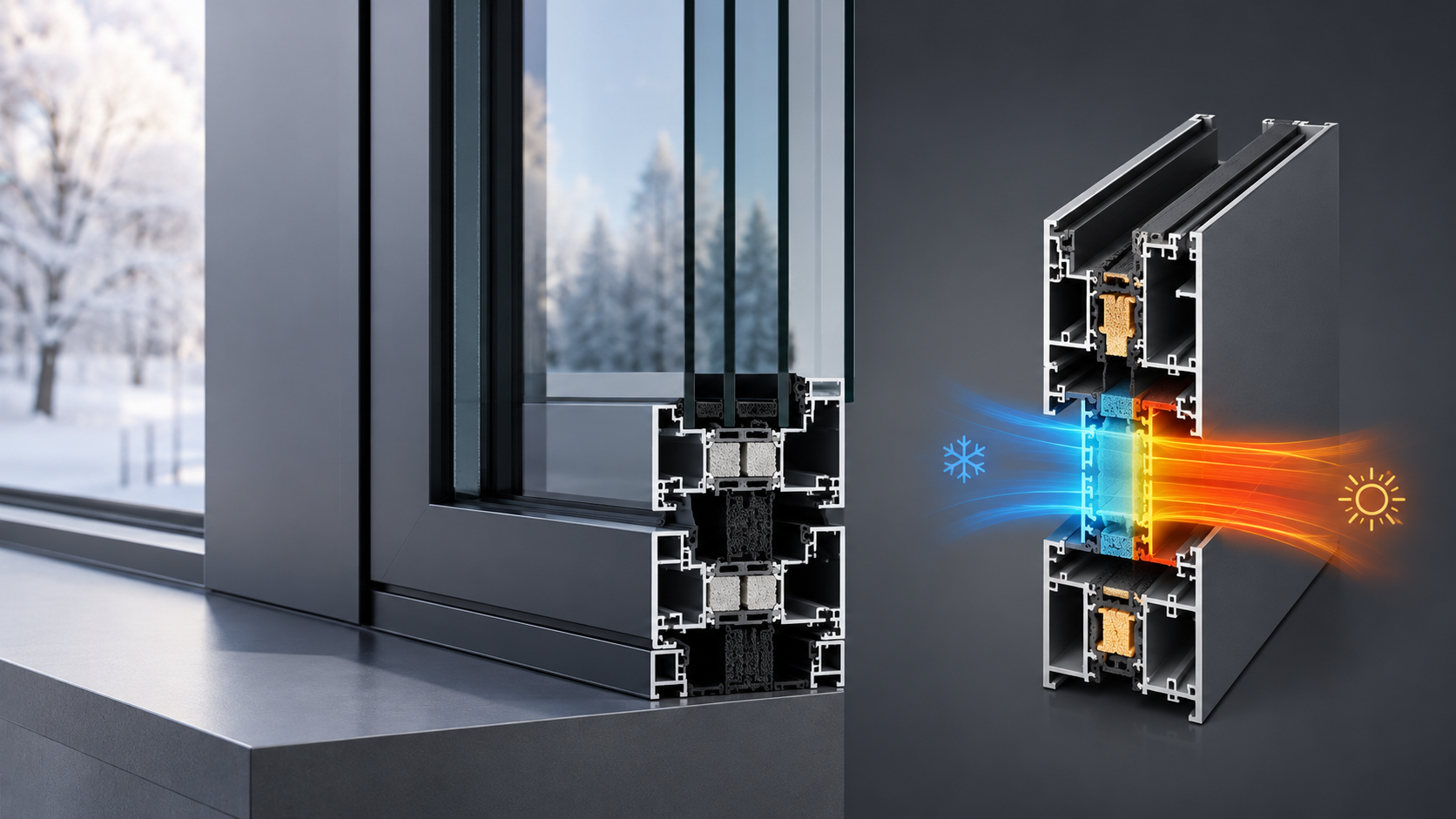
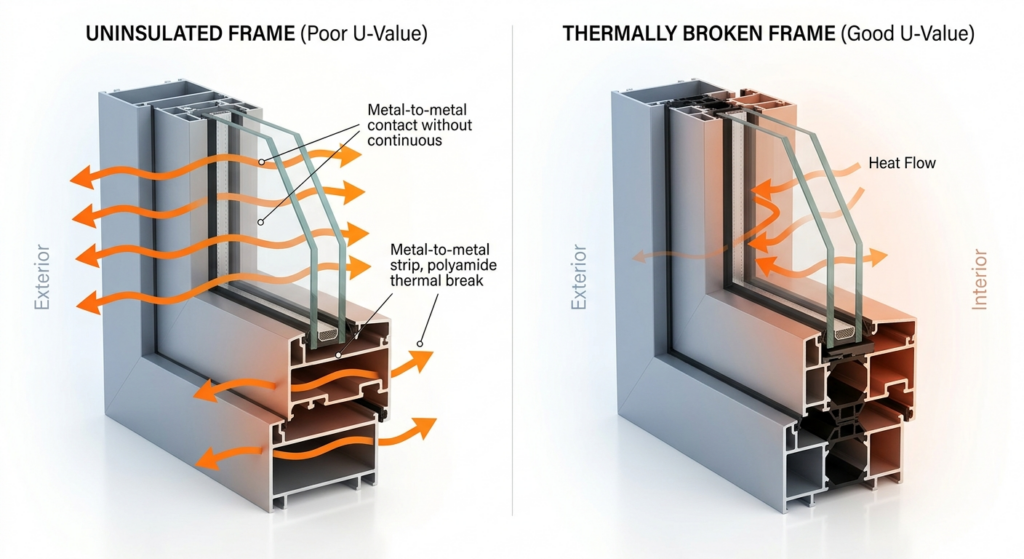
A thermal break is an insulating barrier placed inside an aluminum window frame to stop heat from passing straight through the metal. aluminum conducts heat fast, roughly 1,000 times faster than the polyamide plastic used as the barrier. Without a break, an aluminum frame acts like a bridge: warmth leaves the heated room and crosses the metal to the cold outside in minutes.
The barrier is usually a strip of glass-reinforced polyamide, a tough nylon-based plastic that resists heat flow. Manufacturers split the frame into an inner section and an outer section, then bond the two halves with the polyamide strip between them. The plastic carries the structural load while blocking the conductive path. European systems such as Rehau and VEKA, which Vision Art Aluminium uses in its tilt-turn line, build this barrier into the profile.
The break also changes the temperature of the inner frame surface. With the metal path cut, the room-side frame stays warmer in winter. This single design feature separates a thermally broken aluminum window from a basic one, and it is the main reason a frame can earn a low U-value at all.
Why does a lower U-value matter for energy efficiency?
A lower U-value matters because it directly cuts the heat a building loses through its windows, which in turn lowers heating and cooling demand. Windows are often the weakest point in a wall: a unit rated at 2.8 W/m2K loses twice the heat of one rated at 1.4 W/m2K across the same area. Over a New Jersey winter, that gap shows up on the utility bill.
The U-value works alongside two related ratings on an NFRC label. Solar heat gain coefficient (SHGC) measures how much sun heat enters through the glass, and visible transmittance measures how much daylight passes through. A window can have a strong U-value yet still overheat a room in summer if its SHGC is high, so the three numbers are read together.
Energy codes set the ceiling. The International Energy Conservation Code (IECC), the model code most United States states adopt, caps window U-factors by climate zone. New Jersey and New York sit largely in zones 4 and 5, where the IECC limits fenestration to roughly 0.30 to 0.32 Btu per hour per square foot per degree Fahrenheit (about 1.7 to 1.8 W/m2K) for new homes.
How do thermal breaks reduce condensation?
Condensation forms when warm indoor air meets a surface colder than its dew point, the temperature at which water vapor turns to liquid. On a non-broken aluminum frame, the room-side metal runs cold because heat escapes through it, so moisture beads on the frame and sill. A thermal break keeps that inner surface warmer and pushes it above the dew point.
The relevant rating here is the condensation resistance figure, an NFRC score from 1 to 100 where a higher number means the window resists fogging better. Frames with a polyamide barrier consistently score higher because the warm inner face stays drier. This protects the wall around the window from the mold and rot that repeat condensation can cause.
Vision Art Aluminium pairs thermal aluminum frames with insulating glass on its sunroom builds, using double-glazed tempered Low-E glass with a waterproof seal. Low-E (low emissivity) glass carries a microscopic metal coating that reflects heat back into the room, which raises the inner glass temperature and works with the frame break to hold condensation off both surfaces.
What U-value ranges apply to common window types?
U-value ranges vary widely by glazing and frame construction, so a single window type can span a broad band depending on its build. The table below lists typical whole-window U-values in both metric (W/m2K) and the United States U-factor scale (Btu per hour per square foot per degree Fahrenheit). Figures are general industry references, not ratings for any one product.
| Window type | U-value (W/m2K) | U-factor (Btu/h-ft2-F) | Heat performance |
| Single glazing, no break | 5.0 – 5.8 | 0.88 – 1.02 | Poor |
| Double glazing, non-broken frame | 2.8 – 3.4 | 0.49 – 0.60 | Moderate |
| Double glazing, thermal break | 1.3 – 1.8 | 0.23 – 0.32 | Good |
| Double glazing, Low-E, thermal break | 1.1 – 1.4 | 0.19 – 0.25 | Strong |
| Triple glazing, thermal break | 0.7 – 1.0 | 0.12 – 0.18 | Highest |
The frame share of the loss grows as glazing improves. In a triple-glazed unit, a poorly insulated frame can undo the glass gain, which is why a deep polyamide barrier becomes more important at the low end of the scale. The whole-window number on the NFRC label reflects this combined result.
What are common misconceptions about U-values and thermal breaks?
U-value misconceptions usually come from confusing the glass rating with the whole-window rating. Several myths recur in the fenestration market, and each one changes how a buyer reads a quote. The list below sets out the most frequent errors.
- Center-of-glass U-value is not the whole-window U-value. The glass-only figure ignores the frame and edge, so it always looks better than the certified unit number.
- aluminum is not automatically a poor insulator. A thermally broken aluminum frame can match many materials once the polyamide barrier cuts the metal path.
- A low U-value does not guarantee a cool summer room. Solar heat gain coefficient controls summer overheating, and it is a separate rating.
- Thicker glass does not mean a lower U-value. The insulating gas gap between panes and the coatings drive performance, not raw glass thickness.
- A thermal break is not the same as a weather seal. The break stops conductive heat loss; the gasket stops air and water leakage. Both are needed.
The NFRC label resolves most of these myths in one place. It lists the whole-window U-factor, the SHGC, visible transmittance, and condensation resistance, all measured under the same test method so two units compare fairly.
How are U-values and thermal breaks applied in practice?
U-values and thermal breaks reach a real project through the frame system a manufacturer selects and the glass it pairs with that frame. Vision Art Aluminium runs its tilt-turn windows on the ST70 insulated system from Rehau and VEKA, with hidden hinges and a glass corner option. The ST70 profile carries the polyamide barrier that gives the frame its insulating value.
The brand applies the same logic across its aluminum windows and its sunroom systems, which combine thermal aluminum frames with double-glazed tempered Low-E glass. On its single hung line, the HRW4 series uses a 9/16-inch thermal break and reaches a design load of plus 70 and minus 80 psf, with Miami-Dade and Florida approval for hurricane resistance.
Specification starts with the climate zone and the local energy code. A New Jersey or New York installer matches the required U-factor to a frame and glazing package that meets or beats the IECC ceiling. The certified whole-window number, not a glass-only figure, is the value that satisfies the code and the building inspector.
U-values and thermal breaks: the bottom line
A window U-value measures how fast heat leaves a complete window, and a lower number always performs better on the NFRC scale. The frame is half the story: an aluminum profile only earns a strong rating once a thermal break cuts the metal heat path. The polyamide barrier that creates that break is the single feature separating an efficient aluminum window from a basic one.
Thermal breaks also keep the inner frame surface warmer, which raises condensation resistance and protects the surrounding wall from moisture damage. Energy codes such as the IECC tie these numbers to climate zone, so the right U-factor for a New Jersey window is set by code, not by preference. Reading the U-value, SHGC, and condensation resistance together gives the full picture of how a window will perform.
This content is for general informational purposes only and is not engineering or code-compliance advice. Verify current U-factor requirements and product ratings against the applicable local energy code and the NFRC label before specifying a window.
Frequently Asked Questions
What is a good U-value for an aluminum window?
A good whole-window U-value for an aluminum window in a cold or mixed United States climate sits near or below 1.4 W/m2K (about 0.25 Btu per hour per square foot per degree Fahrenheit). Thermally broken double glazing with Low-E coating reaches this band. The IECC sets the legal ceiling by climate zone, so the required figure depends on location.
How does a thermal break work?
A thermal break works by inserting a polyamide plastic strip inside the aluminum frame, splitting it into inner and outer halves. Aluminum conducts heat about 1,000 times faster than the plastic, so the barrier cuts the conductive path. This lowers the frame U-value and keeps the room-side surface warmer in winter, which also reduces condensation on the frame.
Why does a lower U-value matter?
A lower U-value matters because it directly reduces the heat a building loses through its windows, cutting heating and cooling demand. A window rated at 1.4 W/m2K loses about half the heat of one rated at 2.8 W/m2K over the same area. Windows are often a wall’s weakest point, so the rating shows up clearly on utility bills.
What are the common misconceptions about U-values?
The most common misconception is treating the center-of-glass U-value as the whole-window number; the glass-only figure ignores the frame and always looks better. Another is assuming aluminum insulates poorly, when a thermal break changes that. A low U-value also does not stop summer overheating, which the separate solar heat gain coefficient controls.
How do you get started with comparing window U-values?
Start by reading the NFRC label, which lists the certified whole-window U-factor, solar heat gain coefficient, visible transmittance, and condensation resistance under one test standard. Match the U-factor to the IECC requirement for the local climate zone. Confirm the figure is the whole-unit rating, not a glass-only number, before comparing two products.