

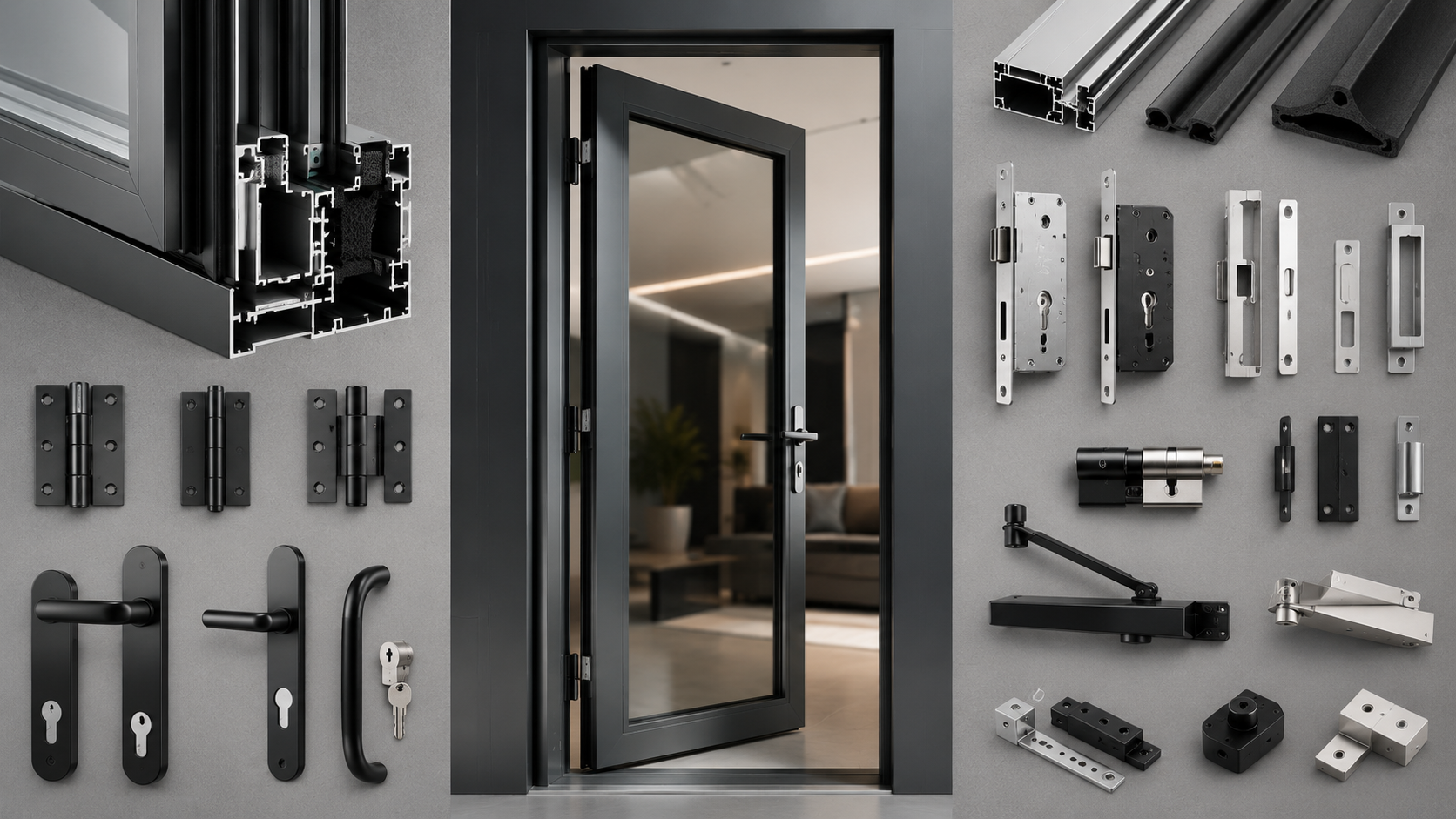
Aluminum Door Parts and Components Explained (with Names)
What are the main parts of an aluminum door?
An aluminum door is built from a fixed outer frame, one or more moving panels, and a set of sealing and hardware components that connect the two. The frame anchors to the wall opening, the panel swings or folds inside it, and gaskets, locks, and hinges control air, water, and access. Vision Art Aluminium, a Montclair, New Jersey contractor and manufacturer serving New Jersey and New York, builds these systems using European hardware partners such as Giesse, G-U, and Siegenia. A standard residential aluminum door uses roughly 8 to 12 distinct named components.
The terminology stays consistent across door types. A pivot door, a french door, and a bi-fold door share the same vocabulary for frame, sash, threshold, and seal, even though the way each panel moves differs. Knowing the names helps when reading a quote, ordering a replacement gasket, or comparing two manufacturer specifications. The list below names each part once and states what it does.
What does each aluminum door component do?
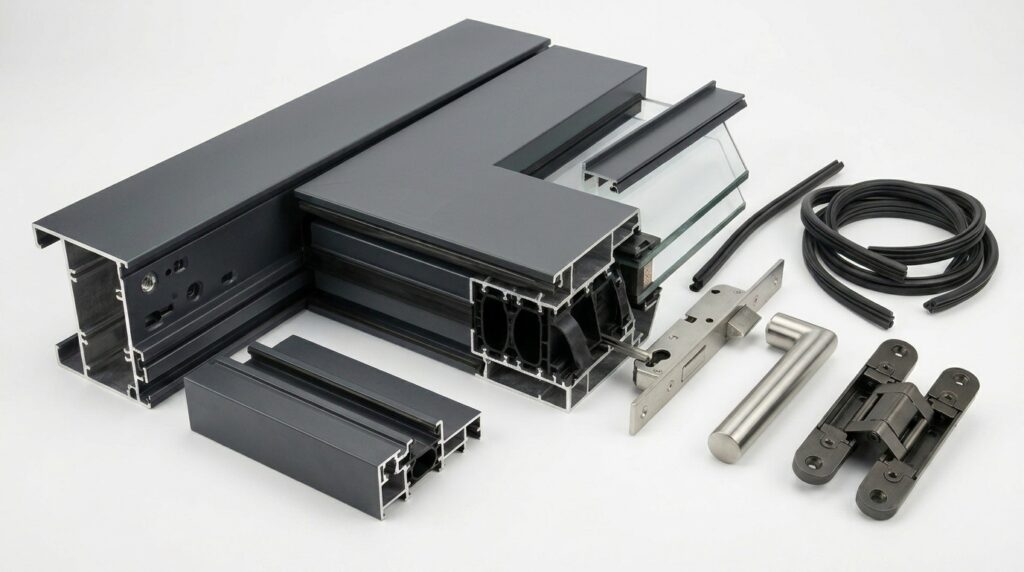
Each aluminum door component performs one job in the assembly, and the parts work as a chain. The frame carries load, the sash holds the glass, the threshold meets the floor, and the seals close the gaps that the moving panel leaves. The table below pairs every part name with its function.
| Component | Function |
| Frame and jamb | The fixed outer profile anchored to the wall opening; the jamb is the vertical side member that the panel hinges or latches against. |
| Leaf or sash | The moving panel that opens and closes; holds the glass unit and carries the handle and lock. |
| Threshold or sill | The bottom horizontal member at floor level; manages water drainage and the door-to-floor transition. |
| Thermal break | An insulating strip, usually polyamide, set inside the aluminum profile to stop heat transfer between inside and outside. |
| Gasket or weatherstripping | Flexible rubber or EPDM seals along the frame and sash that block air and water leakage. |
| Hinge or pivot | The mechanism the panel rotates on: edge-mounted hinges for standard and french doors, a top-and-bottom pivot box for pivot doors. |
| Multi-point lock | A locking system that engages the frame at several points along the sash edge with one handle turn. |
| Handle | The lever or pull that operates the latch and lock from inside and outside. |
| Glazing bead | The removable trim strip that holds the glass unit inside the sash and can be unclipped for glass replacement. |
What is the frame, jamb, and threshold?
The frame is the fixed aluminum perimeter that fastens to the structural opening and receives the moving panel. It splits into named members: the head at the top, the jamb on each vertical side, and the threshold or sill at the bottom. The jamb is the part most people interact with, because the lock keep and the hinge plates fasten to it. On a Vision Art Aluminium pivot door, the frame can be sized far larger than a standard door, because pivot systems can run about 4 times the size of a normal hinged door.
The threshold deserves separate attention because it sits at the wettest, most walked-on point of the assembly. A low threshold improves accessibility but needs careful drainage detailing to stop water pooling. The sill on a sliding system carries the bottom track and panel weight: the S50 sliding door supports up to 800 lbs per panel, so its sill and rollers are engineered for that load.
Why does the thermal break matter?
The thermal break is an insulating barrier, typically a polyamide strip, placed inside the aluminum profile to separate the interior face from the exterior face. Aluminum conducts heat readily, so without this break the metal would carry cold or heat straight through the door and cause condensation. The break interrupts that path, which is why modern energy-rated aluminum doors are described as thermally broken. This single internal part drives most of the door’s insulation rating.
Glass choice works alongside the thermal break. Vision Art Aluminium pairs broken profiles with insulated glazing, and its sliding door is described as performing 2 to 2.5 times warmer than other aluminum sliding doors. The break and the glass are two separate components solving the same problem: heat loss across the opening.
How do the gaskets, hinges, and locks work together?
The gaskets, hinges, and locks form the moving-and-sealing system of an aluminum door. Gaskets, also called weatherstripping, are the flexible seals that compress when the panel closes and block air and water. Hinges or pivots let the panel rotate, and the multi-point lock pulls the sash tight against those gaskets at several points at once. When all three are correct, the door seals evenly along its whole edge rather than only at the handle.
- Gaskets sit in channels along both the frame and the sash, creating a double line of contact.
- Edge hinges suit standard and french leaves; hidden hinges keep the sightline clean on premium systems.
- A multi-point lock spreads clamping force, so a tall panel does not bow or leak at its mid-height.
- Handles from partners such as Giesse, G-U, and Siegenia drive the lock and the latch in one motion.
The handle is the user-facing end of this chain. Vision Art Aluminium’s sliding door uses the Bodrum Handle Family, a named hardware line matched to that system. Specifying the wrong handle family can mean it does not engage the lock points, which is why handle and lock are ordered as a set.
What is the glazing bead and the sash?
The glazing bead is the removable aluminum trim strip that holds the glass unit inside the sash. It clips into place after the glass is set, and it can be unclipped without dismantling the whole door, which is how a cracked pane gets replaced. The sash, also called the leaf, is the moving frame around the glass that carries the bead, the handle, and the lock. Together they form the part that actually swings, slides, or folds.
On premium systems the bead and sash are designed for slim sightlines. Vision Art Aluminium offers a pivot door with 6 wood interior finishes and a fiberglass exterior, and a blinds-between-the-glass option that seals the blind inside the sealed glass unit. That option lives in the glass cavity, so the glazing bead still removes normally for service.
How do pivot, french, and bi-fold doors differ in their parts?
Pivot, french, and bi-fold doors share the same component names but differ in how the panel moves and which hardware carries it. A pivot door rotates on a top-and-bottom pivot box instead of side hinges, which lets it carry a much larger and heavier leaf. A french door uses a pair of side-hinged leaves that meet in the middle. A bi-fold door uses several panels linked by hinges that fold flat to one side like an accordion.
Pivot doors
Pivot doors swap edge hinges for a pivot mechanism set into the threshold and head. Vision Art Aluminium builds pivot doors on a Reynaers system in single, 2-panel, and 3-panel layouts. The pivot box and a heavier frame are the parts that distinguish this type, because the leaf can run about 4 times the size of a standard door.
French doors
French doors use two hinged leaves and add an astragal, the vertical seal where the two panels meet. The inactive leaf usually carries flush bolts top and bottom, while the active leaf holds the main multi-point lock and handle. Vision Art Aluminium lists the french door as a live product within its NJ and NY range.
Bi-fold doors
Bi-fold doors run their panels on a top track with intermediate hinges and rollers, so the parts list adds a carriage and a track that the swing types do not need. Vision Art Aluminium makes bi-fold windows and doors custom for uses such as kitchen serveries, pool houses, and terraces, where the panels fold away to open the full span.
Which aluminum door parts should you check first?
Aluminum door performance comes down to a short set of named parts, and three of them carry most of the result. The thermal break decides insulation, the gaskets decide air and water tightness, and the lock-and-hinge set decides security and how evenly the panel seals. The frame, sash, threshold, handle, and glazing bead complete the assembly, and each maps to one clear job. For homeowners in New Jersey and New York, Vision Art Aluminium supplies pivot, french, sliding, and bi-fold systems built on European hardware from Reynaers, Giesse, G-U, and Siegenia, where these components are matched as engineered sets rather than mixed parts. You can review the configured systems on the company’s aluminum doors range.
This guide describes general aluminum door anatomy for informational purposes; verify exact specifications, finishes, and current product availability with the manufacturer before ordering.
Frequently Asked Questions
What are the main parts of an aluminum door?
An aluminum door’s main parts are the frame and jamb, the moving leaf or sash, the threshold or sill, the thermal break, the gaskets or weatherstripping, the hinges or pivot, the multi-point lock, the handle, and the glazing bead. The frame is fixed to the wall, the sash moves inside it, and the seals and hardware connect and close the two.
How does a thermal break work in an aluminum door?
A thermal break is an insulating strip, usually polyamide, set inside the aluminum profile to separate the inside face from the outside face. Aluminum conducts heat quickly, so the break interrupts that path and reduces heat loss and condensation. A door built this way is called thermally broken, and the break drives most of its energy rating.
What is the difference between a frame, a jamb, and a threshold?
The frame is the whole fixed perimeter fastened to the wall opening. The jamb is the vertical side member of that frame, the part the hinges and lock keep attach to. The threshold, also called the sill, is the bottom horizontal member at floor level that manages drainage and the floor transition. All three are fixed and do not move.
How do pivot, french, and bi-fold doors differ?
Pivot, french, and bi-fold doors differ in how the panel moves. A pivot door rotates on a top-and-bottom pivot box and carries a large leaf. A french door uses two side-hinged leaves meeting in the middle with an astragal seal. A bi-fold door folds several hinged panels along a top track to clear the opening.
Can a glazing bead be removed to replace glass?
A glazing bead is the removable trim strip that holds the glass unit inside the sash, and it can be unclipped without dismantling the door. That design lets a cracked pane be taken out and replaced from the sash. On systems with blinds between the glass, the blind sits in the sealed unit, so the bead still removes for normal service.
Want to see these components in a finished system? Explore our aluminum sliding doors lineup.