


Aluminum Curtain Wall Systems: How They Work and Where They’re Used
What is an aluminum curtain wall?
An aluminum curtain wall is a non-structural outer skin of a building, made from aluminum framing and glass infill panels. The system hangs on the building’s floor slabs and carries only its own weight plus wind and seismic loads, not the weight of the floors above. The aluminum frame is the mullion-and-transom grid, meaning the vertical and horizontal bars that hold each glass or panel unit in place. Vision Art Aluminium, a New Jersey contractor based in Montclair, builds aluminum curtain wall systems for projects across New Jersey and New York.
Curtain wall framing uses aluminum for one structural reason: weight. aluminum weighs roughly one third of steel for the same volume, so a tall facade stays light while spanning large openings. Vision Art Aluminium pairs this framing with European system partners, including Schuco (Germany), Reynaers (Belgium), and Rehau (Germany). These partners supply the extruded profiles and gaskets that define each system’s thermal and weather performance.
The term separates two ideas: a load-bearing wall and a hung envelope. A masonry bearing wall carries the structure above it. A curtain wall does the opposite: the structure carries the wall. This single distinction explains why the glass facades on modern office towers can run floor to ceiling without thick supporting piers.
How does an aluminum curtain wall work?
An aluminum curtain wall works by transferring its loads back to the building frame through anchor brackets at each floor level. Wind pushes against the glass and frame, and the anchors carry that force into the concrete or steel slab edges. Each glass unit sits inside an aluminum pocket sealed with gaskets and structural sealant, so the panel stays watertight while still flexing slightly under wind pressure.
Drainage is the second working principle. A curtain wall is a pressure-equalised rain screen, meaning it manages water that gets past the outer seal rather than relying on one perfect barrier. Small weep holes in the aluminum mullions let trapped water drain back to the outside. This drained-and-back-ventilated design is why a properly built facade can shed driving rain for decades.
Thermal control depends on the thermal break, an insulating polyamide strip set inside the aluminum profile. Bare aluminum conducts heat fast, so the break splits the frame into an inside half and an outside half. The break reduces heat loss in winter and heat gain in summer. Double or triple glazing with a Low-E (low-emissivity) coating adds to that control by reflecting radiant heat back toward its source.
What is the difference between stick-built and unitized systems?
Stick-built and unitized are the two construction methods for an aluminum curtain wall, and they split the work between the factory and the job site. A stick-built system arrives as loose parts: individual mullions, transoms, and glass, assembled piece by piece on the building. A unitized system arrives as finished frame-and-glass modules that are craned into place and locked together. The choice shapes cost, schedule, and quality control.
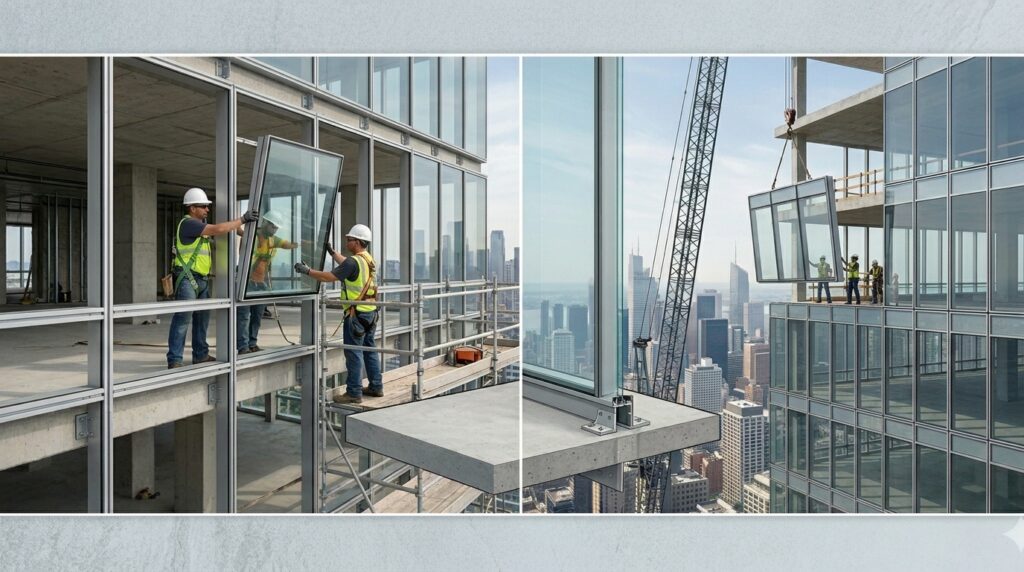
| Factor | Stick-built | Unitized |
| Assembly location | On site, piece by piece | In factory, as modules |
| Typical use | Low to mid-rise, smaller facades | High-rise, large repetitive facades |
| Site labour | Higher, skilled trades on scaffold | Lower, crane plus small crew |
| Quality control | Field-dependent | Factory-controlled |
| Install speed | Slower per bay | Faster per floor |
| Upfront tooling | Lower | Higher |
Stick-built suits smaller buildings where site access is easy and the facade area is modest. The trade-off is that sealing and glazing happen outdoors, so weather and crew skill affect the result. Stick systems also need scaffold or swing stages, which extend the schedule on taller jobs.
Unitized suits high-rise towers with repeating floor plates. Each module is glazed and tested indoors, then hung from the slab edge in one lift. The factory setting gives tighter tolerances and faster floor-by-floor enclosure. The cost sits higher at the start because the factory needs tooling and a confirmed design before production begins.
Where are aluminum curtain walls used?
aluminum curtain walls are used on commercial and institutional buildings where large glass facades, daylight, and a clean exterior matter. The system appears most often on structures that need a continuous outer skin rather than punched window openings. The applications below cover the common building types.
- Office towers and high-rise commercial buildings, where unitized facades enclose floors quickly.
- Hotels and mixed-use developments that want floor-to-ceiling glazing in rooms and lobbies.
- Hospitals, universities, and civic buildings that need daylight and controlled solar gain.
- Retail frontages and showrooms where transparency draws attention to the interior.
- Atriums, entrance lobbies, and stairwells that use glass for an open, lit feel.
Residential use exists but stays narrower. High-end apartments and penthouses adopt curtain wall glazing for views and light. For most homes, framed window and door systems do the job at lower cost, which is why curtain wall lives mainly in the commercial world.
Why does the aluminum curtain wall matter for a building?
An aluminum curtain wall matters because it controls daylight, weather, and energy at the same time, in one assembly. The glass area brings natural light deep into floors, which cuts the need for daytime electric lighting. The thermal break and insulating glass limit heat flow, which lowers heating and cooling demand on the mechanical system.
Weather protection is the second reason. The drained rain-screen design keeps water out while letting the structure move with temperature and wind. Aluminum resists corrosion through a natural oxide layer, and factory finishes such as anodising or powder coating extend that protection. This is why curtain walls hold their appearance over long service lives with limited upkeep.
Performance is measured, not assumed. Engineers rate a curtain wall on air infiltration, water penetration, and structural load under standards published by ASTM (American Society for Testing and Materials) and the AAMA (American Architectural Manufacturers Association). Project mock-ups are tested against these standards before the real facade goes up, which is how a design proves it meets its weather and structural targets.
What are common misconceptions about curtain walls?
Curtain walls carry several misconceptions, and the first is structural. A curtain wall does not hold up the building. It carries only its own weight plus wind and seismic forces, then transfers them to the frame. People also assume the glass alone keeps water out, but the gaskets, sealants, and internal drainage channels do the real work behind the visible surface.
A second misconception treats all glass facades as energy wasters. Older single-glazed walls did lose heat fast. Modern systems with a thermal break, double or triple glazing, and Low-E coatings reach far better insulation values. The performance gap between an old and a current curtain wall is large, so the building’s age matters more than the glass area alone.
A third confuses curtain walls with window walls. A window wall sits between floor slabs and rests on the slab below. A true curtain wall passes continuously in front of the slab edges and hangs from them. The visual result can look similar, but the structural path and the detailing at each floor differ.
Aluminum curtain walls: the practical verdict
An aluminum curtain wall is the right envelope when a building needs large glass areas, daylight, and a controlled weather barrier in one system. The aluminum frame stays light enough to span tall facades, while the thermal break and insulating glass manage energy. Stick-built fits smaller, lower buildings and keeps upfront cost down. Unitized fits high-rise towers and trades higher tooling cost for factory quality and faster enclosure. The decision rests on building height, facade size, and schedule, not on appearance alone. Vision Art Aluminium builds these systems for New Jersey and New York projects using European-engineered profiles from Schuco, Reynaers, and Rehau.
This content is for informational purposes only and does not replace project-specific engineering advice. Verify structural, thermal, and code requirements with a licensed professional before specifying a facade system.
Frequently Asked Questions
What is an aluminum curtain wall?
An aluminum curtain wall is a non-structural building envelope made from aluminum framing and glass infill. It hangs on the building’s floor slabs and carries only its own weight plus wind and seismic loads. The frame transfers these forces to the structure, while the structure carries the floors. The result is a continuous outer skin of glass and metal.
How does an aluminum curtain wall work?
An aluminum curtain wall works by anchoring to each floor slab and transferring wind and seismic loads into the building frame. Glass units sit in sealed aluminum pockets, and internal weep holes drain any water that passes the outer seal. A thermal break inside the frame, combined with insulating glass, limits heat flow between inside and outside.
What is the difference between stick-built and unitized curtain walls?
The difference is where assembly happens. A stick-built curtain wall is built piece by piece on the job site from loose mullions, transoms, and glass. A unitized curtain wall arrives as finished factory modules that are craned into place and locked together. Stick-built suits smaller buildings, while unitized suits high-rise towers needing fast, factory-controlled enclosure.
Where are aluminum curtain walls used?
Aluminum curtain walls are used mainly on commercial and institutional buildings: office towers, hotels, hospitals, universities, and retail frontages. These structures need large glass areas, daylight, and a continuous weather barrier. High-rise towers favour unitized systems for speed. Residential use stays limited to high-end apartments and penthouses, since framed window systems cost less for typical homes.
How do you get started with a curtain wall project?
You start a curtain wall project with a design consultation that defines the facade size, building height, and performance targets. From there, a contractor produces drawings, secures permits, and selects a stick-built or unitized system. Vision Art Aluminium follows a consultation, design, drawings, manufacturing, and installation process for projects in New Jersey and New York.
Looking at glazing options beyond curtain walls? Our aluminum window systems page covers tilt and turn, fixed, and panoramic units.